Do Personal Safety Alarms Actually Work? What the Decibel Rating Doesn't Tell You
Quick Answer: A safety alarm’s decibel rating matters less than its duration and pin-pull design — look for 120+ dB sustained for 20+ seconds and a pull-pin that can’t be pushed back in by an attacker. Sound alone doesn’t stop anyone; it buys you the seconds to move.
You clip one to your keys, feel a little safer, and never test it again. That’s the problem — most people buy a safety alarm the way they buy a smoke detector: install and forget. But an alarm you haven’t tested is a coin flip in the one moment you need it to work.

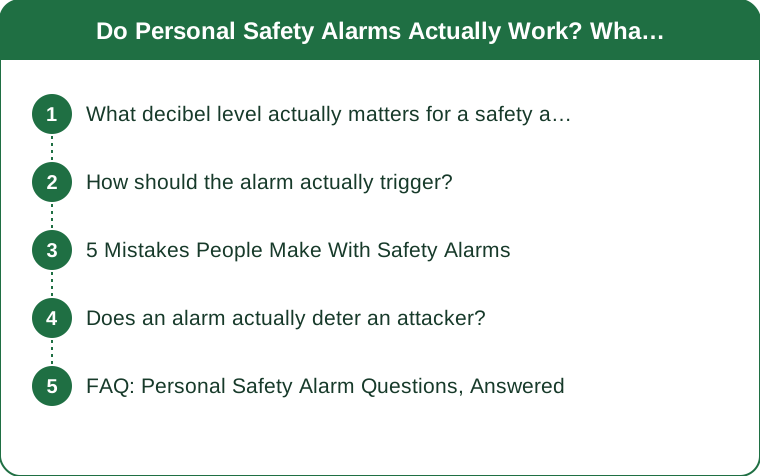
What decibel level actually matters for a safety alarm?
120-140 dB is the useful range — loud enough to be startling and to carry over traffic or wind. Below 100 dB, it competes poorly with ambient city noise and often gets ignored.
But decibels are only half the spec. A 130 dB alarm that dies after 5 seconds is far less useful than a 120 dB one that screams for 30. Duration is what actually draws attention and rattles an attacker’s timeline — check the product listing for a stated run time, not just a dB number.
How should the alarm actually trigger?
Pull-pin designs beat button designs for one simple reason: under adrenaline, fine motor control drops sharply, and a small button is hard to find and press. A pin attached to your keyring activates the second it’s pulled away from the unit — no aim required.
Test yours once a month in an empty room. Alarms sit in bags for years; batteries corrode, pins stick. A device you’ve never fired is a guess, not a tool.

5 Mistakes People Make With Safety Alarms
1. Burying it in a bag. If it takes 10 seconds to dig out, it’s not a safety device — it’s a paperweight. Clip it somewhere your hand reaches without looking.
2. Never testing after purchase. Batteries die. Test monthly, replace yearly regardless of use.
3. Treating it as a standalone plan. An alarm is one layer. Pair it with awareness habits and a known exit route — it’s a supplement, not a substitute.
4. Choosing looks over pull-pin mechanics. Cute keychain shapes often sacrifice a reliable pin for aesthetics. Function first.
5. Assuming it works underwater or in extreme cold. Cheap units fail below freezing. If you’re often outdoors in winter, check the operating temperature range.
Does an alarm actually deter an attacker?
The evidence is more about disruption than deterrence. A sudden 130 dB blast breaks an attacker’s plan — most predatory approaches rely on control and quiet, and a loud alarm does the opposite of both. It also flags bystanders faster than a scream, which tires out and can be muffled.
Think of it as a timeline disruptor: it doesn’t guarantee someone stops, but it very reliably makes them hesitate — and hesitation is what creates your window to move toward people, lights, or a door.
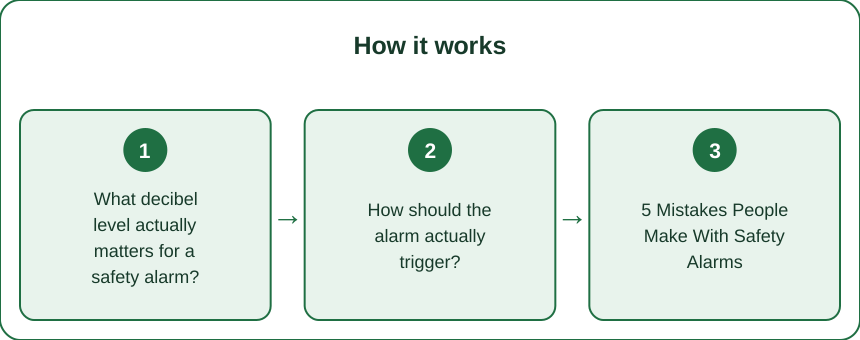
FAQ: Personal Safety Alarm Questions, Answered
Are safety alarms legal everywhere?
Yes — alarms are legal in all 50 states, unlike pepper spray, which has state and even city-level restrictions. That makes an alarm a safe first layer for travel.
How long do the batteries last?
Most replaceable-battery models last 1-2 years of monthly testing plus occasional real use. Rechargeable models should be topped off every 3 months even if unused — standby drain is real.
Should I get one with a strobe light too?
If you’re often out at dusk or in low-visibility areas, yes — the strobe helps bystanders locate you faster than sound alone, especially in a crowd or parking structure.
TL;DR:
- Chase duration (20+ seconds) and pull-pin design over raw decibel numbers
- Test the alarm monthly — an untested alarm is a guess, not a tool
- Clip it somewhere reachable without looking, not buried in a bag
- It’s a timeline disruptor, not a guarantee — pair it with awareness and an exit plan
Buy for reliability, not looks, and actually test the thing. That’s the whole difference between a safety device and a decoration.
Keep Reading
This article is for general informational and styling purposes only. Fit, sizing, and product availability may vary.