Why a Plan You Have Said Out Loud Works and One You Only Thought About Doesn't
Quick Answer: A plan you have only thought about lives in a part of your processing that goes offline under acute stress. A plan you have said aloud, walked through, or physically rehearsed is stored closer to motor memory, and motor memory survives the adrenaline response far better. That is the entire difference. Saying your plan out loud once is worth more than thinking about it fifty times — not because speech is magic, but because it forces the plan into specifics your body can execute.
Most people’s safety plan is a vague intention.
Vague intentions are exactly what stress deletes first.

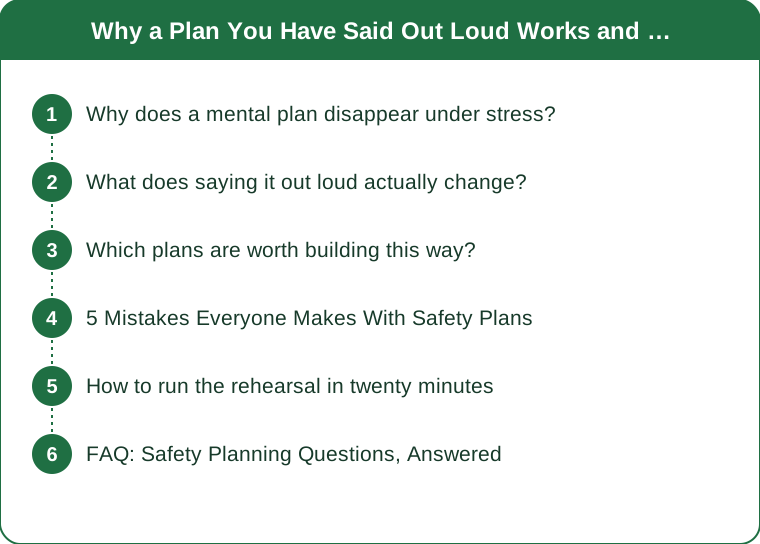
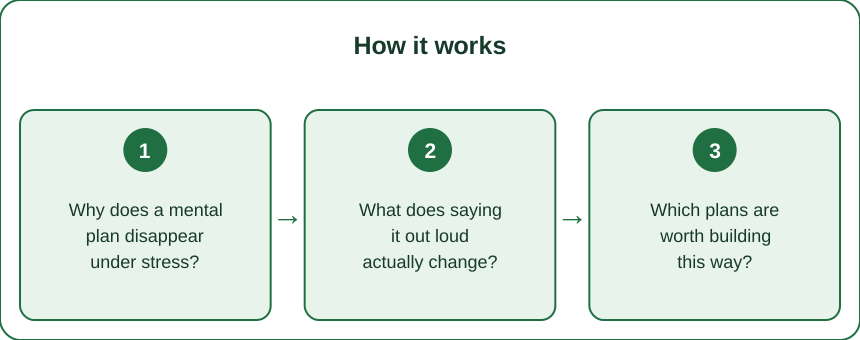
Why does a mental plan disappear under stress?
Because acute stress narrows what you have access to.
When the threat response fires, a well-documented set of things happens quickly: heart rate climbs, peripheral vision narrows, fine motor control degrades, and complex deliberate reasoning gets slower and less reliable. What remains functional is anything sufficiently rehearsed to run without deliberation.
A plan that exists as a thought — if someone follows me I’ll go somewhere busy — requires several decisions in the moment. Which direction is busy? Is that shop open at this hour? Do I cross now or at the corner? Each of those is a deliberation, and deliberation is precisely the resource under pressure.
A plan that has been spoken and walked is different. “If I feel followed on this street, I cross to the pharmacy on the corner and go in” contains no decisions left to make. It is a trigger and an action.
This is why professionals in high-stress fields rehearse verbally and physically rather than reading procedures. The reading produces knowledge; the rehearsal produces availability.
The uncomfortable version of this: most people who have thought carefully about personal safety have knowledge and no availability.
What does saying it out loud actually change?
It forces specificity, and specificity is the whole game.
Try it once and the mechanism is obvious. A thought can stay comfortably vague. A sentence cannot. The moment you say “if X happens, I will…” out loud, you discover that you do not actually know the end of the sentence, and finishing it is the work.
Three things happen when you speak it:
The gaps become audible. “I’d go somewhere safe” sounds fine in your head and sounds obviously incomplete out loud. Where? How far? What if it is closed?
The plan gets timed. Speaking takes real seconds, which gives you an honest sense of whether a sequence is realistic. Plans that take twelve seconds to describe often take considerably longer to do.
It gets encoded differently. Material that has been produced — spoken, written, physically enacted — is remembered better than material that has only been reviewed. This is one of the more robust findings in learning research and it is why rereading is a poor study strategy.
Walking the route while saying it is better again, because it adds real environmental cues. The corner you actually turn at becomes the trigger, rather than an abstract corner.
Which plans are worth building this way?
Not many. Three or four, covering the situations that actually recur in your life.
The temptation is to plan for dramatic scenarios. The useful version is the opposite — plan the mundane transitions where most incidents genuinely occur:
The walk from where you park to where you are going. Specifically at night. Name the lit route, name the one open business, name the point at which you would turn around.
Getting into your car. The most common gap here is the loading period — bags in first, distracted, door open. A spoken plan for this is usually two sentences long.
Arriving home. Keys ready before you are at the door, and a specific plan if something looks wrong when you arrive rather than a general intention to be careful.
Someone approaching you while you are stationary. At a bus stop, a petrol station, waiting for a lift. This is the one almost nobody plans, and it is the one where freezing is most common.
That is it. Four spoken plans, each two or three sentences, each rehearsed once out loud and ideally once on foot. The whole exercise takes about twenty minutes and does more than a term of classes for these specific situations — not because classes are useless, but because classes teach technique and this teaches availability.
Seasonal note worth flagging: as the evenings draw in over the next several weeks, the routes you walk in daylight all summer become night routes on the same schedule. Plans built in July frequently do not survive October’s lighting.

5 Mistakes Everyone Makes With Safety Plans
1. Planning the fight instead of the exit. Most spoken plans people produce start at the moment of contact. Almost all useful plans end before contact. If your plan’s first action is physical, you have planned the last resort and skipped four earlier options.
2. Leaving the trigger vague. “If I feel unsafe” is not a trigger, because feeling unsafe is exactly the state in which you second-guess whether you are overreacting. “If the same person is behind me after I cross the road” is a trigger — observable, binary, and it removes the judgement call.
3. Making the plan depend on your phone. Fine motor control degrades under adrenaline and unlocking a phone, opening an app and typing is a surprisingly demanding sequence. A plan that begins with your phone is a plan with a failure point at step one.
4. Never saying the awkward part. The hardest thing for most people is not running or fighting — it is being rude. Saying “No. Back up.” loudly to someone who has not clearly done anything wrong feels socially catastrophic, and that social cost is what produces hesitation. Rehearse the sentence out loud, at volume, at least once. It is the single most awkward and most valuable item on this list.
5. Building it once and never revisiting it. Your routes, hours, neighbourhood and car change. Here is the part that surprises people who have done this well once already — a plan that fits your summer routine can be actively misleading in November, because the specific lit shop your whole plan depended on now closes ninety minutes earlier.
How to run the rehearsal in twenty minutes
Concrete instructions, because a vague method produces vague plans.
Step 1 — pick your four situations. Use the list above, or substitute the ones that match your actual week. Write them down. Four maximum.
Step 2 — write the trigger for each. One observable condition. Not a feeling. It must be something you could point at.
Step 3 — write two or three actions. Concrete, in order, no branching. Where you go, what you say, who you contact and when. Name real places.
Step 4 — say each one out loud, standing up. All four. It takes about three minutes and it will feel ridiculous. The ridiculousness is not a sign it is not working.
Step 5 — say the confrontation sentence at volume. Once. “Back up.” or “Stop following me.” Loudly enough that you would be heard across a car park. Almost nobody has ever produced this volume before and the first time is the hard one — that is exactly why it should not be during an incident.
Step 6 — walk one of them. Pick the route you use most and actually walk it, saying the plan as you go. This is the step that converts a script into something environmental.
Step 7 — diarise a re-run for the clock change. Twice a year, when the light shifts, run the four again. Five minutes.
This is general safety information, not training, and it is not a substitute for professional instruction or for contacting the police if you believe you are at risk.
FAQ: Safety Planning Questions, Answered
Does saying it out loud really matter, or is that just a device?
It matters for two concrete reasons. It forces the plan to be specific enough to be sayable, and produced material is retained better than reviewed material. You could get most of the same benefit by writing it out longhand and walking it. Thinking about it does not produce either effect.
Isn’t rehearsing this going to make me anxious?
Most people report the opposite after the fact, and the mechanism is straightforward — a resolved question stops recurring. Unplanned worry loops; planned contingencies tend to go quiet. If rehearsing does raise your anxiety persistently, that is worth talking to a professional about rather than pushing through.
How often should I re-run them?
Twice a year is enough for most people, tied to the clock changes so you do not have to remember. Re-run sooner if you move, change jobs, or change your commute.
Should I rehearse with someone else?
Saying them to another person is more effective than saying them alone, and it has the side benefit that someone else knows your plans. It also usually improves them — other people spot the gaps in your route faster than you do.
What if the plan fails in the moment?
Then you improvise, which is what you would have done anyway — except now you are improvising from a starting point instead of from nothing. A plan is not a guarantee. It is a way of not spending your first three seconds deciding.
TL;DR:
- Acute stress degrades deliberate reasoning first, which is exactly where an unspoken plan lives
- Saying a plan aloud forces the specificity that makes it executable, and produced material is retained better
- Build four plans for mundane transitions — walking to your car, getting in, arriving home, being approached while stationary
- Triggers must be observable and binary, never “if I feel unsafe”
- Rehearse the confrontation sentence at real volume once, because being rude is the part that causes hesitation
Set aside twenty minutes this week, stand up, and say four two-sentence plans out loud. It will feel silly, it will be the least dramatic safety work you ever do, and it will be available to you in a way that reading never is.
Keep Reading
This article is for general informational and styling purposes only. Fit, sizing, and product availability may vary.