Heads-Up: Everyday Situational Awareness Without the Paranoia
Quick Answer: Useful situational awareness is relaxed alert, not constant vigilance. Practise it in three places: a 3-second read when you enter a space (exits, who’s there, general vibe), eyes up and phone away during the 90 seconds of transitions — parking lots, stairwells, entrances — and one earbud out in transit zones. That’s it. Anything more exhausting than that won’t survive the month.
Situational awareness usually gets taught in two broken settings.
Setting one: paranoid hypervigilance. Scan every face, assume every stranger, live like the parking garage is a war zone. It’s exhausting, and people abandon it within two weeks.
Setting two: nothing. The phone-absorbed default, where you could not describe the last four people you walked past.
The useful setting is in the middle — and crucially, it’s a handful of habits at specific moments, not a personality you have to adopt.

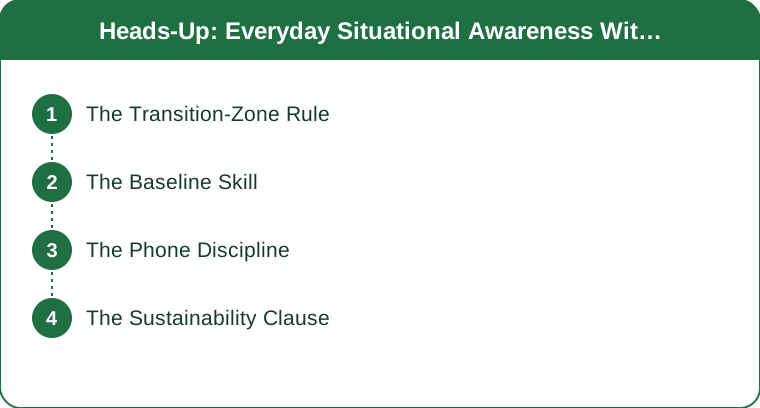
Where Does Awareness Actually Matter?
At transitions — the between-places where attention naturally lapses and where most opportunistic incidents happen.
The transition zones:
- Parking lots and garages, especially the walk to and from the car.
- Stairwells and elevators, where sightlines are short.
- Entrances and exits of buildings, transit stations, ATMs.
- The moment you’re getting into or out of a car — keys out, door unlocked, hands full, attention on the bags.
The habit is small: phone pocketed, eyes up, for the ninety seconds of transit. Not all day. Just the zones.
Two supporting moves that cost nothing: have your keys in hand before you leave the building rather than digging at the car door, and once you’re in the car, lock it and drive — the parked-in-the-lot phone-scroll is the single most common vulnerable moment people create for themselves.
What Is the “Baseline” Skill?
Awareness is mostly about noticing normal, so that abnormal registers on its own.
When you walk into a café, a train carriage or a parking structure, take a three-second read:
- Where are the exits?
- Roughly who’s here, and what’s the general energy?
- Is anything obviously out of place with that?
That’s it. Three seconds, and after a few weeks it runs subconsciously.
The reason this works better than “scanning for threats” is that threat-scanning is undefined and endless — you can do it forever and never feel finished. Baseline-reading has a completion point. And because your brain is very good at flagging deviation from an established pattern, the abnormal thing tends to announce itself without you hunting for it.
A useful related habit from the same family: when you sit down somewhere, take the seat facing the door if it’s available. Not because of anything dramatic — it just means you never have to turn around to know what’s happening.

How Does Your Phone Fit Into This?
The phone is awareness’s off switch, and the fix isn’t abstinence — it’s making it a stationary activity.
- Check navigation inside the shop, before you start walking, not mid-block with your head down.
- One earbud out, or both at half volume, in transit zones. You can keep the podcast; you just need to hear a bike, a car, or a voice behind you.
- Head up at the crosswalk, always, even on streets you’ve crossed a thousand times.
That last one deserves emphasis, because it’s where the real numbers are: cars, curbs and bikes injure vastly more people than any dramatic scenario. Distracted-walking injuries at intersections are a genuine, boring, common problem. If you adopt exactly one habit from this article, make it that one.
Practical version of the rule: if you’re moving, the phone is away. If the phone is out, you’re standing still.
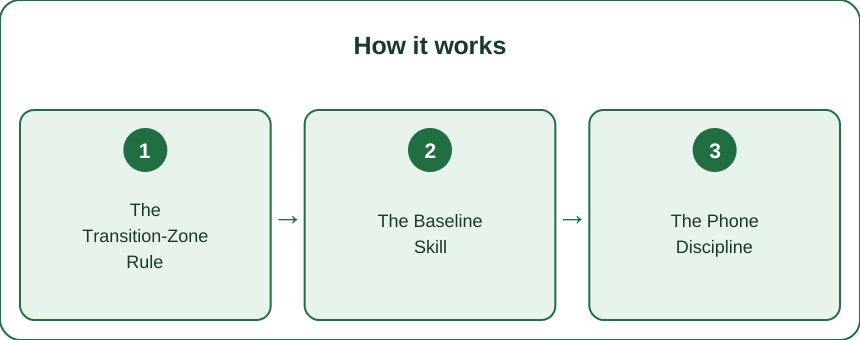
Myth vs Fact: Situational Awareness
Myth: Being aware means constantly scanning for danger. Fact: It means knowing what normal looks like so deviations stand out. Constant scanning is unsustainable and produces more anxiety than information.
Myth: More awareness is always better. Fact: Hypervigilance has real costs — sleep, mood, and the paradox that exhausted people notice less. A sustainable middle setting outperforms an unsustainable maximum.
Myth: You should trust your gut only when you can justify it. Fact: Every self-defense curriculum ever taught says the opposite. If something feels wrong, leave. You do not owe anyone an explanation, and you do not have to build a case first.
Myth: Awareness is about strangers. Fact: Statistically, most harm comes from people you know. Awareness habits are worth having, but they’re one layer among several, not a complete safety strategy.
Myth: Looking confident is a technique you perform. Fact: It’s mostly a byproduct. Head up, unhurried pace, hands free — those come naturally from the habits above, and they read as confidence without any acting involved.
Why Does the Middle Setting Actually Stick?
Because it costs almost nothing.
Three-second room reads. Ninety seconds of attention in transitions. Phone as a stationary activity. Gut trusted without litigation.
Add them up and it’s maybe four minutes of deliberate attention across an entire day. That’s the whole reason it survives — sustainable habits are the only ones still running in six months, and a habit that’s running is worth vastly more than an intense practice you dropped in March.
Awareness done right is barely noticeable, even to you. Which is exactly the point.
When to see a professional: if you find yourself unable to stop scanning, avoiding places you used to go, or experiencing persistent anxiety about safety — especially after a specific incident — that’s worth talking to a therapist about. Hypervigilance is a recognised trauma response and it responds well to treatment. Likewise, a good in-person self-defense class teaches this material far better than any article can.
What is situational awareness in simple terms?
It’s noticing what’s normal in a space so anything unusual stands out. In practice it’s a quick read on entry — exits, who’s around, general feel — plus keeping your head up and phone away during transitions between places.
How can I be more aware without becoming paranoid?
Attach awareness to specific moments rather than running it constantly: entering a space, walking through a parking lot, crossing a street. Bounded habits are sustainable; continuous vigilance isn’t, and it costs you sleep and mood without adding much safety.
Is it safe to wear headphones while walking?
It’s a trade-off. Use one earbud or half volume in transitions, parking areas and near traffic, and save full volume for places where you can already see everything around you. Traffic is the realistic risk here far more than anything else.
TL;DR:
- Aim for relaxed alert, not hypervigilance — the sustainable setting is the effective one.
- Awareness matters most in transitions: lots, garages, stairwells, entrances.
- Do a 3-second baseline read on entry — exits, people, feel. Abnormal then self-announces.
- Phone is a stationary activity. Moving means head up, one earbud out.
- Head up at every crosswalk — traffic out-injures every dramatic scenario combined.
- Trust your gut and leave. You don’t have to justify it to anyone, including yourself.
Keep Reading
This article is for general informational and styling purposes only. Fit, sizing, and product availability may vary.