How Much Does Phone Distraction Actually Undermine Situational Awareness?
Quick Answer: Phone use significantly narrows peripheral awareness and reaction time in public spaces, more than most people realize, and reducing phone use during specific vulnerable moments — walking alone, waiting at a bus stop, entering a parking lot — matters more for situational awareness than most specific self-defense techniques.
A lot of situational awareness advice focuses on what to notice, but the more immediate issue for many people is a phone actively preventing that noticing from happening at all.

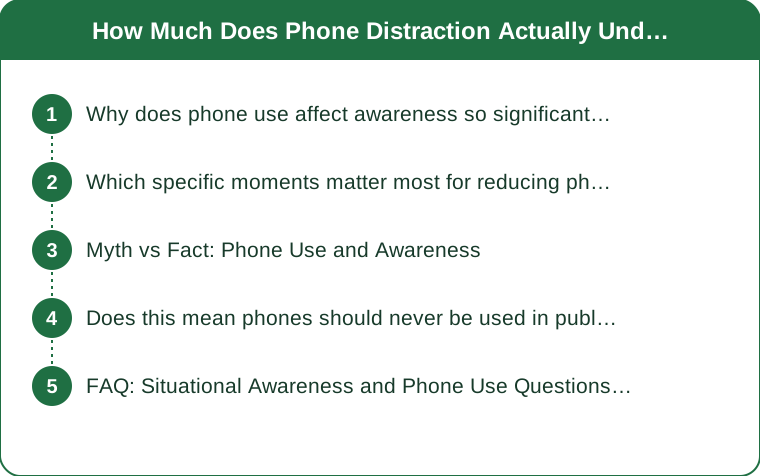
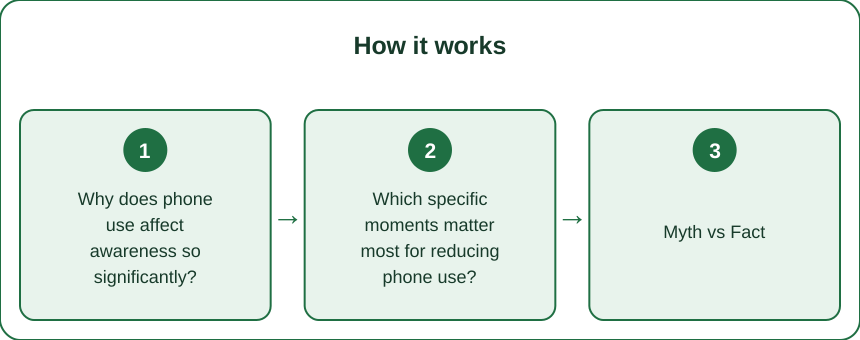
Why does phone use affect awareness so significantly?
Looking at a phone screen narrows visual attention to a small area directly in front of the face, cutting off the peripheral vision that’s normally a key part of noticing approaching people or changing surroundings.
Audio distraction from headphones compounds this further, removing an entire sense that would otherwise contribute to overall situational awareness.
Which specific moments matter most for reducing phone use?
Transition points — walking to a car, entering or exiting a building, waiting alone at a bus stop or train platform — are widely considered higher-vulnerability moments where phone-free awareness matters most.
These transition points are also when people are most likely to be looking at their phone, whether checking directions, a message, or simply passing time, which is exactly the mismatch worth addressing.

Myth vs Fact: Phone Use and Awareness
Myth: quickly glancing at a phone doesn’t meaningfully reduce awareness. Fact: even brief phone checks measurably reduce peripheral awareness and reaction time for the duration of the glance and slightly after.
Myth: situational awareness is mainly about learning to read other people’s behavior. Fact: removing self-created distractions like phone use is often a more immediately actionable step than developing more advanced behavioral reading skills.
Does this mean phones should never be used in public?
Not entirely — the more practical guidance is being deliberate about when and where phone use happens, rather than eliminating it, particularly avoiding it during higher-vulnerability transition moments.
Stepping to a stable, low-traffic spot before checking a phone, rather than doing so while walking through an open or isolated area, captures most of the benefit without eliminating phone use altogether.
FAQ: Situational Awareness and Phone Use Questions, Answered
Does using one earbud instead of two make a meaningful difference?
Somewhat — keeping one ear free preserves some audio awareness, though visual attention from the phone screen remains a separate issue.
Is this advice specific to walking alone at night?
Nighttime and unfamiliar areas increase relevance, but reduced awareness from phone use applies during daytime and familiar areas too, just with generally lower overall risk.
Should navigation apps be avoided entirely while walking?
Not necessarily — glancing briefly and then looking up, rather than staring continuously at a screen while walking, is a reasonable middle ground.
TL;DR:
- Phone use narrows peripheral awareness and reaction time more than most people realize
- Transition points like parking lots and bus stops are higher-vulnerability moments for phone distraction
- Being deliberate about when to check a phone matters more than avoiding it entirely
- Stepping to a stable spot before checking a phone captures most of the benefit
Situational awareness starts with removing self-created distractions — phone timing is one of the most actionable places to start.
Keep Reading
This article is for general informational and styling purposes only. Fit, sizing, and product availability may vary.