Your Voice Is a Self-Defense Tool: Why Loud Beats Skilled in Most Real Situations
Quick Answer: In real encounters, the voice outperforms techniques you’d need years to master: a loud, sharp, command-voice ‘BACK OFF’ disrupts the quiet-compliance script most predatory approaches depend on, draws the attention they’re structured to avoid, and creates decision time — while assertive verbal boundaries at the approach stage (‘Stop. I don’t want help.’) end most situations before anything physical exists. Train the voice like a skill: it fails under adrenaline unless practiced out loud, which almost nobody does. This is general information, not medical advice.
Self-defense marketing sells wrist releases and pressure points — years-to-master physical skills for worst-case moments. Meanwhile the tool with the best real-world usage statistics costs nothing, needs no flexibility, works at range, and is sitting in your throat unpracticed — because practicing it feels embarrassing, which is exactly the inhibition that needs the reps.

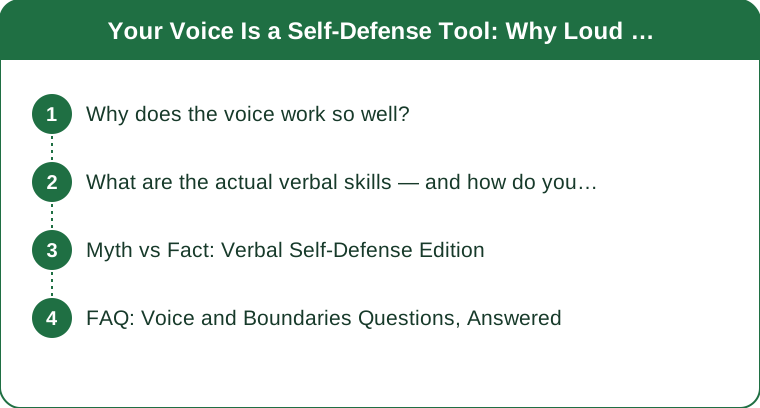
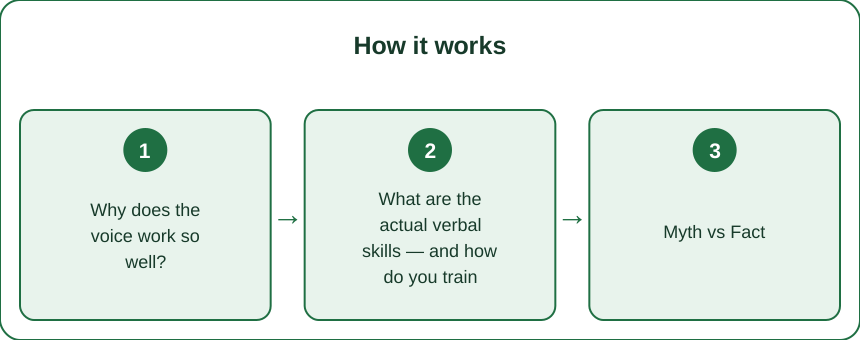
Why does the voice work so well?
Because most problematic approaches are structured around quiet — testing, closing distance, and escalating in ways that avoid attention and rely on the target’s social conditioning to stay polite:
- The script disruption: predatory approaches typically probe compliance first (ignoring soft refusals, closing space incrementally). A sudden loud, sharp command shatters that script — it announces the target is not running the polite-compliance program, and re-selection is cheaper than persistence for someone counting on quiet.
- The attention weapon: unwanted attention is the approach’s structural enemy — a command voice pulls eyes from across a parking lot, and ‘BACK OFF’ identifies the situation for bystanders in a way screaming alone doesn’t (specific words beat wordless noise for triggering intervention and for witnesses’ comprehension).
- The physiological jolt: loud commanding voice startles — buying a beat of hesitation that converts directly into distance and options.
- The internal effect (underrated): committing to the shout breaks your own freeze — voice activation and body activation travel together, which is why command-voice training doubles as freeze-response training.
And the statistical frame worth internalizing: resistance research on real encounters consistently finds that assertive verbal and physical resistance associates with better outcomes than passive compliance in most stranger-threat contexts — the voice isn’t the consolation tool; it’s the front-line one. This is general information, not medical advice.
What are the actual verbal skills — and how do you train them?
The escalation ladder:
- Stage 1 — the assertive boundary (most-used, most-valuable): flat, firm, no-smile, no-apology: ‘Stop.’ / ‘I don’t need help.’ / ‘Leave me alone.’ — delivered with squared shoulders and eye contact, while creating distance. The social-conditioning battle lives here: the boundary must survive the tester’s ‘I’m just being friendly’ counterattack, and the practiced response is repetition, not justification (‘I said no.’). Persistence past a clear boundary IS the diagnostic — decent people stop.
- Stage 2 — the fence + command voice: hands up, palms out (the ‘fence’ — reads as de-escalation to cameras and witnesses, functions as a ready barrier), with volume stepped up hard: ‘BACK OFF. NOW.’ Short words, chest voice, maximal volume — trained shout, not scream.
- Stage 3 — the alarm layer: ‘CALL 911’ aimed at specific bystanders (‘You in the red shirt — call 911’) outperforms general shouting for mobilizing help.
The training method (the part everyone skips): the command voice must be rehearsed out loud — car-alone practice, pillow-muffled if needed, ideally a class with padded-attacker scenario drills where you shout under stress. Under adrenaline, unpracticed voices go quiet or shrill; practiced ones deploy. Ten minutes of genuinely loud practice monthly maintains it — embarrassment during practice is the tax that buys availability under pressure.

Myth vs Fact: Verbal Self-Defense Edition
Myth: Yelling makes an attacker angry — quiet compliance is safer. Fact: The resistance literature runs the other way for most stranger scenarios — immediate assertive resistance associates with better outcomes and does not show the escalation penalty the myth predicts. (Context matters — weapons, domestic situations, and robbery-of-property scenarios each have their own risk calculus, which is what quality training covers — but ‘quiet is always safer’ is not what the data says.)
Myth: ‘Fire’ is the magic word because nobody responds to help-shouts. Fact: Internet folklore — the evidence-informed guidance favors specific, situation-naming commands (‘BACK OFF’ at the person; ‘CALL 911’ at named bystanders) over gimmick words. Bystander mobilization improves with clarity and assignment, not with pretending there’s a fire.
Myth: Verbal skills are the ‘soft’ option before the real (physical) self-defense. Fact: Sequence-wise it’s the opposite — awareness and verbal boundaries handle the approach phase where nearly all encounters are decided, and physical skills exist for the small fraction that get past them. The voice isn’t the warm-up act; it’s the show. (And the best physical-skills classes teach exactly this hierarchy: awareness, voice, positioning, then technique.)
The deeper reframe: the hardest part of verbal self-defense isn’t technique — it’s permission: decades of socialization toward politeness, quiet, and not-making-a-scene. The practice reps aren’t training the vocal cords; they’re training the permission.
FAQ: Voice and Boundaries Questions, Answered
What if I misread the situation and yell at someone harmless?
The asymmetry answers it: the cost of a false alarm is mutual embarrassment; the cost of a suppressed alarm is the whole reason this article exists. And Stage 1 exists precisely as the graduated response — a firm ‘No thank you, leave me alone’ embarrasses no one, and only persistence past it escalates the ladder. People who respect the boundary were never the problem.
My voice shakes when I’m scared — will this even work?
That’s the training case, not the disqualifier: shaky-but-loud works (volume and words carry the effect; steadiness is garnish), and rehearsal reliably deepens and steadies the command voice under stress. Scenario-based classes (padded attacker, shout-required drills) are the gold standard for exactly this — one weekend converts most shaky voices.
How do I practice boundaries in low-stakes daily life?
The graduated gym: decline the upsell without apologizing, return the wrong order plainly, say ‘no’ to a request without a paragraph of justification — each rep trains the same no-apology circuitry the safety boundary runs on. The person who can say a flat ‘no thanks’ to a street fundraiser has already built half the skill. This is general information, not medical advice.
TL;DR:
- The voice handles the approach phase where most encounters are decided: assertive boundary → fence + command voice → assigned bystander alarm
- Loud, short, specific beats skilled: ‘BACK OFF’ disrupts the quiet-compliance script and weaponizes attention
- It fails unpracticed — adrenaline mutes untrained voices; ten loud minutes monthly keeps it deployable
- The real training target is permission, not vocal cords — decades of politeness conditioning is the actual opponent
The most effective self-defense tool was never in the technique catalog — it’s been in your throat, waiting for practice permission. This is general information, not medical advice.
Keep Reading
This article is for general informational and styling purposes only. Fit, sizing, and product availability may vary.