What Actually Happens to Your Body in the First Three Seconds?
Quick Answer: Under an acute stress response, heart rate spikes within seconds, fine motor control degrades substantially, peripheral vision narrows, and auditory processing reduces. Any technique requiring precise hand placement, complex sequences, or clear decision-making is likely to fail. Effective self-defense is built from gross motor movements that survive these conditions.
You’ve practiced the technique fifty times in class. The question that matters is whether it works when your hands are shaking, you can’t see anything to your sides, and someone is talking to you and you can’t process the words.

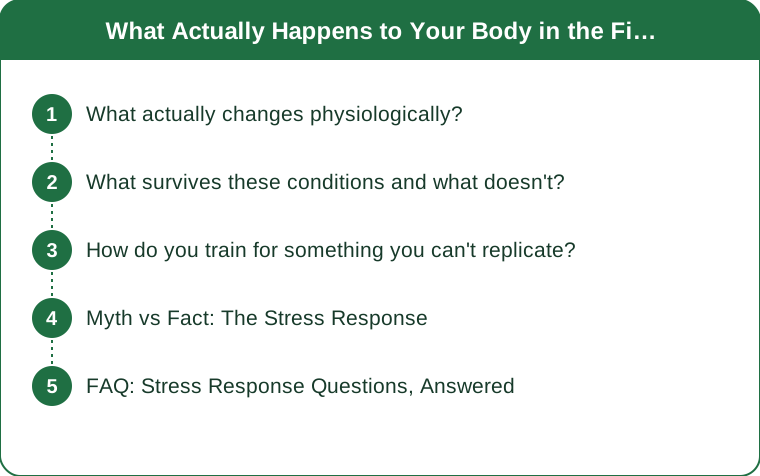
What actually changes physiologically?
Four things, all within the first few seconds, and all working against complexity.
Heart rate spikes sharply. Not from exertion — from catecholamine release. It can go from resting to well over 150 bpm within seconds of a genuine threat.
Fine motor control degrades. As heart rate rises past roughly 115 bpm under stress, precise finger and hand movements become substantially less reliable. This is well documented in law enforcement training research, and it’s why manipulating small objects — keys, a phone, a specific grip — becomes unreliable exactly when you need it.
Peripheral vision narrows. Tunnel vision is a literal, measurable effect. Your visual field can constrict significantly, meaning you may genuinely not see a second person or an exit route to your side.
Auditory processing changes. Many people report either muffled hearing or an inability to process speech during an acute stress response. Instructions, including your own internal ones, don’t land.
Why this matters for what you train
A technique requiring a specific grip on a specific spot, executed in sequence, is a technique built for a body that isn’t in this state. Under stress you get gross motor movements, and you get them at reduced precision — that’s the design constraint, and most self-defense curricula don’t build around it.
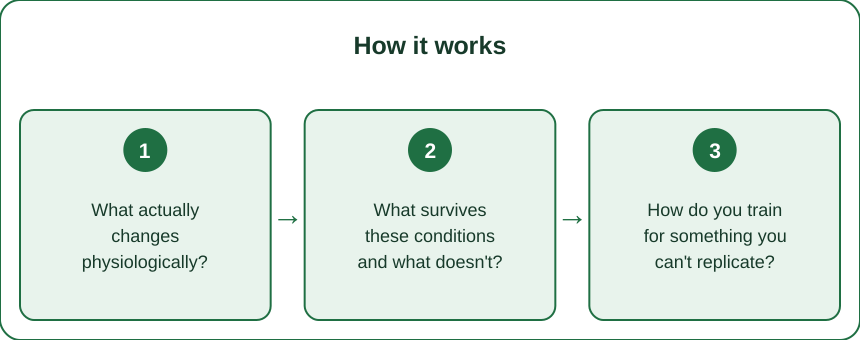
What survives these conditions and what doesn’t?
A fairly clear divide.
What survives: large movements using major muscle groups. Pushing. Pulling away. Running. Striking with the whole body rather than a precise hand position. Loud vocalization. Moving to create distance.
What doesn’t: joint locks requiring precise placement. Multi-step sequences. Anything that depends on the other person responding a specific way. Retrieving and deploying a tool from a bag. Assessing options and choosing between them.
The tool problem is worth being specific about. Pepper spray at the bottom of a handbag is effectively not present — locating it, retrieving it, orienting it, and operating a small safety catch involves exactly the fine motor skills that degrade first. The same tool clipped where your hand already is may be genuinely useful. The tool isn’t the variable; access under degraded conditions is.
The decision problem is the underrated one. Complex decision-making slows dramatically under acute stress. A plan with branches — if this then that, unless this — takes time you don’t have. A single default action you’ve decided on in advance executes far faster.

How do you train for something you can’t replicate?
You can’t fully replicate it, but you can approximate several components.
Train with elevated heart rate. Practicing techniques after 30 seconds of hard effort — burpees, sprinting in place — approximates the motor degradation reasonably well. Techniques that fall apart at 150 bpm in a gym will fall apart in reality.
Train with restricted vision. Practicing with a hood or in low light approximates tunnel vision. It reveals immediately how much a technique depends on seeing clearly.
Train with noise. Loud music or a shouting partner approximates the auditory disruption and prevents you from relying on verbal cues.
Train with a non-compliant partner. The most important one and the most commonly skipped. A partner who moves unpredictably, resists, and doesn’t cooperate is the only way to find out whether a technique depends on cooperation.
Train the default, repeatedly. One response, drilled to automaticity, beats five responses you’d have to select between. Under stress, selection is the expensive step.
Myth vs Fact: The Stress Response
Myth: Adrenaline makes you stronger and faster, so you’ll perform better. Fact: It increases gross power output somewhat while degrading precision, coordination, and judgment. Net effect on a complex skill is usually negative.
Myth: With enough training you won’t experience the stress response. Fact: You’ll experience it regardless. What training changes is how well you function during it — which is a different and more achievable goal.
Myth: You’ll remember your training when it counts. Fact: You’ll access the responses you’ve drilled to automaticity. Techniques you understand but haven’t automated are generally unavailable under acute stress.
Myth: Freezing means you failed. Fact: Freezing is a normal component of the stress response, not a character failure. Training reduces its duration; it rarely eliminates it entirely.
Myth: Awareness training is a soft alternative to physical skills. Fact: Awareness is the only intervention that works before the stress response begins, when your full physical and cognitive capacity is still available. That timing makes it the highest-value thing you can train, not the lowest.
FAQ: Stress Response Questions, Answered
Does this mean martial arts training is useless?
No — but the training method matters more than the style. Any system that includes resistant partners and stress inoculation transfers better than one that doesn’t, regardless of its techniques.
How long does the response last?
The acute phase is typically seconds to minutes. The physiological aftermath — shaking, nausea, exhaustion — can last considerably longer, and it’s worth expecting.
Can I train myself not to freeze?
You can substantially reduce it by rehearsing a single default action until it’s automatic. The freeze often comes from having no pre-selected response.
Is yelling actually effective?
Yes, for several reasons: it’s a gross motor action that works under stress, it attracts attention, and it interrupts your own freeze response.
What’s the highest-value thing to practice?
Creating distance and leaving. It’s the simplest gross motor response, requires nothing of your opponent, and works under every degraded condition described here.
TL;DR:
- Heart rate spikes, fine motor control degrades, vision narrows, and hearing changes within seconds
- Gross motor movements survive; precise grips, sequences, and tool retrieval from bags often don’t
- Complex decisions are the slowest step — pre-select one default action
- Train with elevated heart rate, restricted vision, noise, and a non-compliant partner
- Awareness works before the stress response starts, which is what makes it the highest-value skill
The technique that works is the one that still works when your hands won’t do what you tell them. That’s a much shorter list than most curricula suggest, and knowing which list you’re training from matters.
Keep Reading
This article is for general informational and styling purposes only. Fit, sizing, and product availability may vary.