What Changes About Personal Safety When You Move Somewhere New
Quick Answer: What you lose in a new area is baseline knowledge, not skill. Awareness works by noticing deviations from normal, and you do not yet know what normal is. Rebuild it deliberately in the first month: walk your routes in daylight before you need them at night, learn which places are open late, identify two or three safe stopping points on each regular route, and give the area four to six weeks before trusting your instincts about it.
You were relaxed in your old neighbourhood.
Here, every unfamiliar noise gets your full attention.
That is not paranoia. Your pattern-matching has nothing to match against yet.

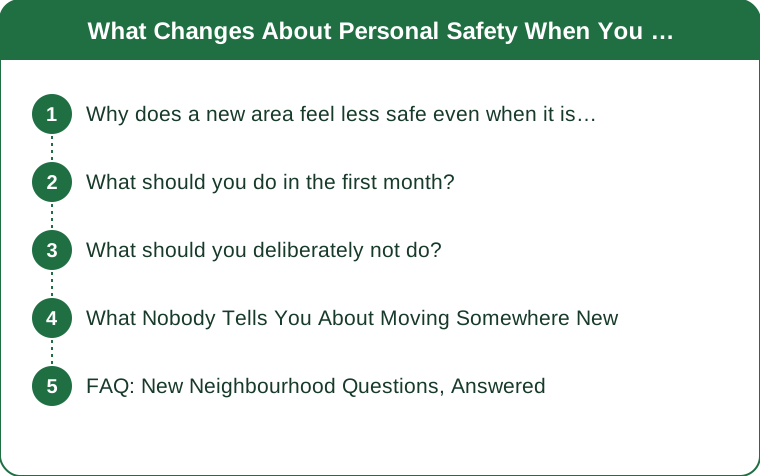
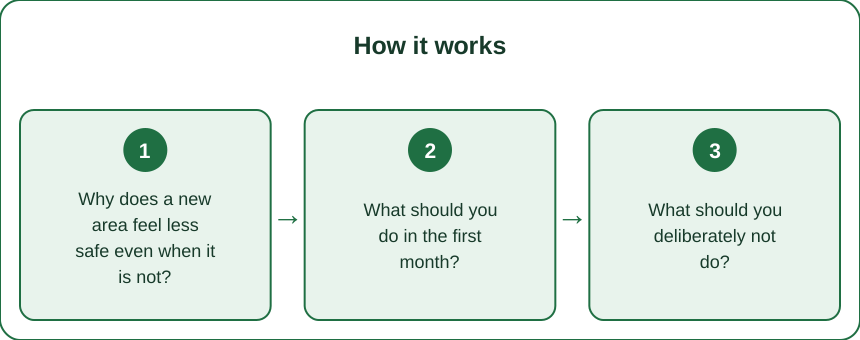
Why does a new area feel less safe even when it is not?
Because awareness depends on a baseline you have not built.
Situational awareness is deviation detection. You notice what is out of place. Without a sense of normal, everything registers as potentially out of place, which is exhausting and not actually informative.
You do not know the rhythms. Which street is busy at 8am and empty at 8pm. When the pub turns out. When the buses stop. These are the details that make a route feel predictable.
You do not know the safe points. In a familiar area you know, without thinking, which shop is open, which building has a doorman, where there are always people. That mental map takes weeks to build.
Your routes are not yet automatic. Navigating while walking means looking at a phone, which is the single biggest reduction in awareness available.
You have no local knowledge. Neighbours, local news, and word of mouth carry information no map has.
And you may be over-correcting. Anxiety in a new place produces either hypervigilance or defiant dismissal. Neither is useful; the deliberate approach below is.
What should you do in the first month?
Six specific things, in a sensible order.
Walk your regular routes in daylight first. Especially the ones you will use at night — the walk from the station, from the bus stop, from a friend’s flat. Knowing a route in daylight makes it dramatically more legible in the dark.
Identify two or three safe stopping points per route. A 24-hour shop, a petrol station, a busy pub, a building with a staffed entrance. Know exactly where they are, so a decision to stop somewhere is instant rather than improvised.
Learn what is open late. This is the most practical piece of local knowledge there is, and it takes one evening walk to gather.
Learn the routes without your phone. Navigating from memory frees your attention. Give yourself a week of deliberately walking the main routes without looking down.
Meet at least a few neighbours. People who know your face are a genuine safety asset, and local knowledge flows through them.
Give it four to six weeks. That is roughly how long it takes for a baseline to form. Do not conclude anything about an area in the first fortnight, in either direction.

What should you deliberately not do?
Four common responses that make things worse.
Do not rely on your phone for navigation at night. Looking down at a lit screen removes your awareness and marks you as unfamiliar with the area. Check the route before you set off, or step into a lit doorway to check.
Do not assume ‘nice area’ means ‘no need to think’. Opportunistic incidents are driven by opportunity, not by postcode averages. The habits are the same everywhere.
Do not abandon your habits because you feel silly. Telling someone your route, keeping keys ready, and choosing lit streets are not a comment on the neighbourhood.
Do not over-correct into avoidance. Refusing to walk anywhere at night means you never build the baseline, which means it never gets easier. Build familiarity deliberately in daylight, then extend.
And a practical one: update your address, your emergency contacts and any location-sharing you use with friends or family in the first week. It is the sort of thing that stays undone for months.
Seasonal note: if you move in autumn, the light changes underneath you. A route you learned at 6pm in September is dark by 6pm in late October, and the same street reads completely differently. Re-walk your key routes once the clocks change rather than assuming what you learned still holds.
What Nobody Tells You About Moving Somewhere New
The first two weeks are the most alert you will ever be there. Use that — you notice more now than you will in three months, and it is worth paying attention to what you observe.
Your instincts are unreliable at first, in both directions. You will feel uneasy on perfectly ordinary streets and comfortable on ones you would question later. Wait for the baseline.
Getting slightly lost is how you learn the area. Deliberate daylight wandering builds a mental map far faster than following turn-by-turn directions.
Local knowledge is the highest-value thing you can acquire. Neighbours, local groups and shopkeepers know things that are not written anywhere.
Your routine becomes visible quickly. Leaving at the same minute every day on the same route is worth varying occasionally, particularly early on.
And the thing that surprises everyone: confidence in your body language changes how you are perceived, and it comes from knowing where you are going. Route familiarity does more for how you carry yourself than any technique you could learn.
This is general information, not professional security or legal advice. Follow local guidance and contact local police services for area-specific concerns.
FAQ: New Neighbourhood Questions, Answered
How long until a new area feels normal?
Usually four to six weeks of regular movement through it. Less if you walk it deliberately rather than only driving.
Should I check crime statistics?
They provide context but not much practical guidance. Knowing which streets are lit and which shops are open late is more useful day to day.
Is it worth walking routes at night on purpose?
Walk them in daylight first, then at dusk, then at night — ideally with someone the first time. Building it in steps works better than either avoiding or diving in.
What should I ask neighbours?
Which routes people use, what is open late, anything they would avoid, and how the area changes on weekends. Most people answer happily.
Should I vary my routine?
Some variation is sensible, particularly in the first months. Complete unpredictability is unrealistic and unnecessary.
What is the single most useful habit?
Knowing your route well enough not to look at your phone. It restores your attention and changes how you carry yourself.
How do I stop feeling anxious about it?
Build familiarity deliberately rather than waiting for the feeling to pass. The feeling follows the knowledge, not the other way around.
TL;DR:
- A new area feels less safe because you have no baseline, not because you are less capable.
- Walk key routes in daylight first, then dusk, then night.
- Identify two or three safe stopping points on each regular route.
- Learn routes off your phone — looking down is the biggest single loss of awareness.
- Give it four to six weeks before trusting your instincts about the place, in either direction.
This weekend, walk the route from your nearest station home in daylight and note what is open late. That is the most useful hour you can spend.
Keep Reading
This article is for general informational and styling purposes only. Fit, sizing, and product availability may vary.