What to Do When You Think Someone Is Following You and You Are Not Sure
Quick Answer: Verify before you react, then escalate in steps. Change direction twice in a way that has no natural reason — cross the street, then cross back or turn a corner. Someone genuinely going your way will not follow both changes. If they do, go directly toward light and people, call someone and stay on the line, and be willing to be wrong loudly. The cost of a false alarm is embarrassment; the cost of waiting for certainty is your margin.
Almost every piece of self-defense advice assumes a clear threat. Real situations rarely announce themselves that way. What actually happens is a feeling — footsteps that match your pace, a car that has passed you twice, someone who was behind you two turns ago and still is — and then a long, uncomfortable argument with yourself about whether you are overreacting.
That argument is the most dangerous part of the situation, because it consumes the time you would otherwise use to create distance and options.

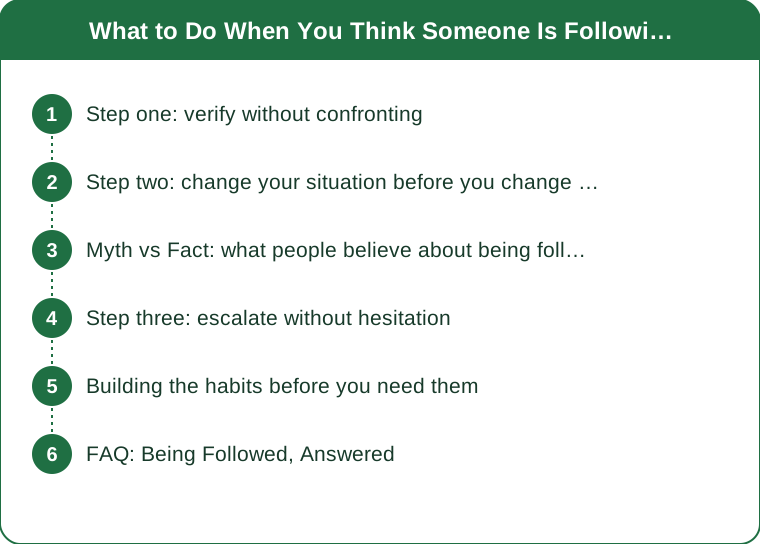
Step one: verify without confronting
The goal is information, not a decision. You want to know whether this person’s path is genuinely coincident with yours, and you can find out in under a minute without them knowing you are checking.
The two-turn test. Make one change of direction that has a plausible reason — cross the street, enter and exit a shop doorway, turn at a corner. Then make a second one shortly after that has no plausible reason, like crossing back or turning again. A person walking their own route will not match both.
Use reflections rather than turning around. Shop windows, parked car glass, phone screen at an angle. Turning to look directly is fine and sometimes useful, but reflections let you gather information without changing the dynamic.
Vary your pace deliberately. Slow noticeably for ten seconds, then resume. Someone genuinely behind you on their own errand will pass you. Someone matching your speed will slow too, and you will feel it.
Trust the physical response. The feeling that made you notice is your pattern-recognition system working faster than your conscious reasoning. It is not always right, but it is worth acting on, and it is not something to talk yourself out of while you gather more data.
Step two: change your situation before you change your behavior
If the verification comes back concerning, the priority is environment, not confrontation.
Move toward light, people, and open businesses — not toward home. This is the single most important reversal of instinct in the whole situation. Going home leads someone to where you sleep, and a residential street at night is the least populated option available.
Pick a specific destination and go to it directly. An open store, a gas station, a restaurant, a hotel lobby, a busy bus stop. Having a concrete target stops the wandering that happens when people try to lose someone without a plan.
Call someone and stay on the line, speaking aloud. Say where you are, what you are seeing, and where you are heading. This does three things: it creates a witness, it signals to the person behind you that this is now documented, and it keeps you narrating specifics rather than spiraling.
Do not put in headphones, and take out the ones you have in. Hearing is most of your remaining information.
Keep your hands free. Whatever tool you carry is useless in a zipped bag. If you carry an alarm or spray, it belongs in your hand once you are at this stage — not because you expect to use it, but because retrieving it later is not realistic.
Myth vs Fact: what people believe about being followed
Myth: You should confront them and show you are not an easy target. Fact: Confrontation closes distance, which is the opposite of what you want. Awareness and distance are the goal. Looking directly at someone once — making it clear you have seen and can describe them — is different from engaging, and it is generally considered useful. A verbal confrontation is not.
Myth: You will know for certain before you need to act. Fact: You almost never will, and waiting for certainty is how people end up with no options. Act on uncertainty, and accept that most of the time you will have been wrong. That is the correct trade.
Myth: Running is always the answer. Fact: Running is an excellent option toward a specific safe place. Running blindly into unfamiliar or darker territory is not, and running when you cannot sustain it leaves you worse off. Walk fast toward light before you run into the dark.
Myth: A weapon solves this. Fact: The overwhelming majority of these situations resolve through distance, visibility, and witnesses. Tools are a last layer, they require training and immediate access to be useful, and they do nothing about the phase you are actually in right now.
Myth: Being wrong about it is embarrassing enough to matter. Fact: Nobody will remember. You are allowed to walk into a store for no reason, call a friend for no reason, and go home ten minutes later than planned.

Step three: escalate without hesitation
If the situation has not resolved after you have changed environment, escalate, and do it earlier than feels comfortable.
Go inside somewhere staffed and tell a person. Not just enter — actually say to an employee that you think someone is following you and you would like to wait a few minutes. This is a completely normal request and staff at most businesses have handled it before.
Call emergency services if the person follows you into a location or continues after multiple changes. You do not need to be certain, and you do not need something to have happened. Describe what you observed factually.
Be loud if they approach. Volume is genuinely effective — it attracts attention, it removes the privacy an approach depends on, and it interrupts a script. Short, direct, specific: back off, or a plain shout. It does not need to be clever.
If you are in a vehicle and think you are being followed, do not drive home. Drive to a police station, a fire station, or a busy well-lit area, and call while driving hands-free if you can.
Afterward, write down what you can remember while it is fresh — time, location, description, direction of travel. If it turns out to matter, that record is the useful thing, and memory degrades fast.
Building the habits before you need them
The response above works far better if a few things are already true.
Know two safe destinations on every route you walk regularly. Not general awareness — specific places, with hours you know. Most people cannot name one on their usual walk home.
Keep your phone charged above a threshold you have decided on, and know how to trigger your phone’s emergency call feature without looking at the screen.
Tell someone your route on unfamiliar walks. A shared location for the duration of a walk costs nothing.
Practice the phrase. People freeze not because they lack a plan but because they have never said the words out loud. Saying I think someone is following me, can I wait here to a stranger is a surprisingly hard sentence the first time. Rehearse it once and it stops being hard.
Vary your routine if you have a regular route and time. Predictability is the precondition for most following behavior.
None of this requires being fearful or living defensively. It requires about ten minutes of thinking done in advance, once.
FAQ: Being Followed, Answered
What if I am wrong and I have embarrassed someone innocent?
You have not done anything to them. Crossing the street, entering a store, and making a phone call are not accusations. There is no version of this where being careful causes harm.
Should I take a different route home every day?
Varying your routine is worthwhile if you have a highly regular pattern, but the more useful habit is knowing safe stopping points along the routes you do use. Familiarity has real safety value too.
Is it better to look at them or avoid eye contact?
A single deliberate look that communicates you have seen and can describe them is generally considered useful. Sustained eye contact or staring can read as engagement. One look, then act.
TL;DR:
- Verify with two direction changes, one of which has no natural reason — a coincidental route will not match both.
- Move toward light, people, and open businesses, never toward home.
- Call someone and stay on the line out loud; take out headphones; keep hands free.
- Escalate early — tell staff inside a business, call emergency services on uncertainty, and be loud if approached.
- Prepare in advance: two known safe destinations per regular route, and the phrase rehearsed once.
Act on the feeling rather than waiting to justify it. Being wrong costs you ten minutes and mild self-consciousness, and that is a price worth paying every single time.
Keep Reading
This article is for general informational and styling purposes only. Fit, sizing, and product availability may vary.