Distance Is the Self-Defense Skill Worth Drilling Before Any Technique
Quick Answer: Every physical technique becomes necessary only after distance has already been lost. Managing space — noticing approach, changing your position, creating angles, and using verbal boundaries early — resolves the overwhelming majority of situations before contact. It is the least taught and most useful skill in personal safety.
The class spent forty minutes on wrist grab escapes.
Nobody spent four minutes on what to do when someone starts walking toward you and something feels off — which is the part that decides whether the wrist grab ever happens.

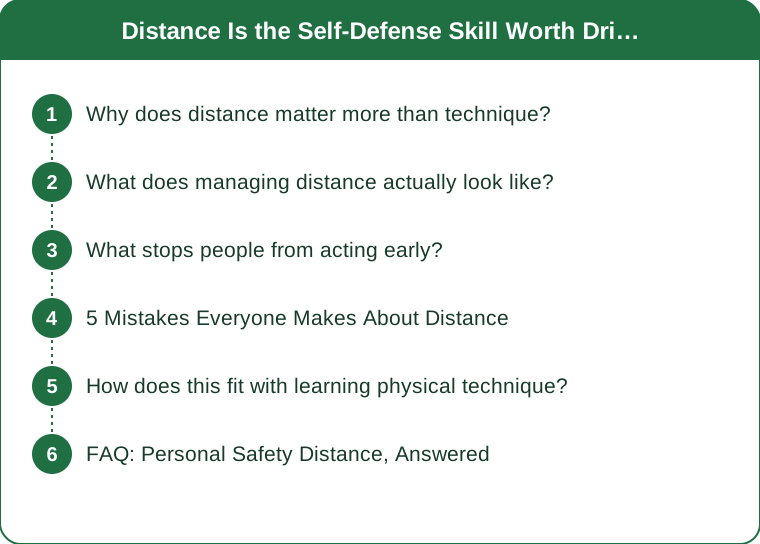
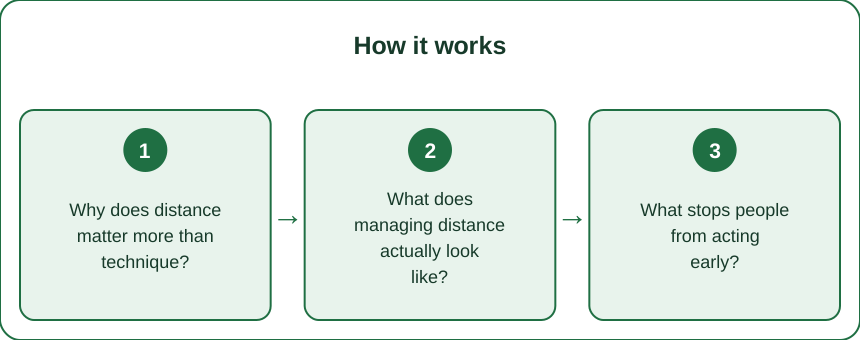
Why does distance matter more than technique?
Because technique is a response to failure, and distance is the thing that prevents the failure.
Once someone is within arm’s reach, you are in the hardest possible version of the problem: a physical confrontation, usually with a size and strength disadvantage, under adrenaline that degrades fine motor control. Techniques for that situation are worth learning. They are also the lowest-probability path to a good outcome.
Everything that happens before contact has much better odds. Changing your walking line, crossing the street, stopping and turning to face someone, putting a physical object between you, or saying something loud and direct — these are all low-cost actions with high success rates, and they are available in the window that most training ignores.
The window is longer than people think. Most approaches involve some period of closing distance, during which you can act. The perception that these situations are instantaneous comes largely from the freeze response, which makes the available time feel like it was not there.
What does managing distance actually look like?
Concrete actions, not abstract awareness:
Change your line. If someone is approaching on a collision path, alter your direction well before you have to. Crossing a street, stepping into a shop, or angling toward a populated area are all decisions that cost you nothing if you were wrong.
Turn and face. Stopping and turning squarely toward an approaching person does two things: it removes the surprise advantage and it signals that you have seen them. A very large share of opportunistic approaches end at this point.
Use objects. A parked car, a bench, a lamppost between you and someone changes the geometry entirely. Anything that has to be walked around buys you seconds and makes intent visible.
Set a verbal boundary early. Loud, clear, and unambiguous — ‘stop’, ‘back up’, ‘I don’t know you’. Early is the operative word. Most people wait until someone is at arm’s length, by which point the boundary is a reaction rather than a barrier.
Keep your hands free and up. Not fists — just hands available, ideally at chest height, which reads as natural gesturing while placing them where they can be used.
None of these require strength, athleticism, or years of training. All of them require having decided in advance that you are allowed to do them.
What stops people from acting early?
Politeness, mostly. And it is not a character flaw — it is a trained response that runs deeper than most safety advice acknowledges.
The specific pattern: you notice something is off, and you immediately begin generating reasons not to react. He is probably just walking the same way. It would be embarrassing to cross the street. He will think I assumed something about him. I do not want to make a scene.
Every one of those thoughts costs you distance while you have it.
The reframe that works is deciding in advance that the cost of being wrong is acceptable. If you cross the street and nothing was happening, you crossed a street. That is the entire downside. Weighed against the alternative, it is not a close call, but it only feels that way if you have thought about it before rather than in the moment.
A useful practice: pick one low-stakes situation this week where something feels slightly off, and act on it. Cross the street. Change carriages. Leave the shop. The point is not the situation — it is proving to yourself that acting is survivable, so the pattern is available when it matters.

5 Mistakes Everyone Makes About Distance
1. Treating awareness as a mental state rather than a set of actions. ‘Be aware of your surroundings’ is not actionable. ‘Look up and scan at every corner, doorway, and parking lot entrance’ is.
2. Waiting for certainty before reacting. You will never be certain, and certainty arrives too late to be useful. Act on the discomfort, not on the confirmation.
3. Keeping headphones in at full volume in transitional spaces. Not a lecture about headphones generally — but stairwells, parking structures, and building entrances are where approach happens, and hearing is where you get the earliest warning.
4. Having both hands occupied. Phone in one hand, coffee in the other, bag on the shoulder is a common configuration and it removes every option you have. One hand free, always, in transitional spaces.
5. Practicing techniques and never practicing the verbal boundary. The loud clear ‘back up’ is a skill that requires rehearsal like any other, and it feels absurd to practice, which is why almost nobody does. It also fails most reliably under stress for exactly that reason.
How does this fit with learning physical technique?
It comes first, and then technique matters — the two are not in competition.
A sensible ordering:
- Distance and awareness. The highest-probability skills, usable by anyone, requiring no physical attributes.
- Verbal boundary setting. Rehearsed out loud, repeatedly, until it is available under stress.
- Escape from contact. Breaking grips, creating space, and disengaging — all of which aim to restore distance.
- Strikes and control. Last, because they are the highest-risk and lowest-probability path.
Notice that item three is also about distance. Nearly every good self-defense technique is a method of getting distance back, not a method of winning a fight. Classes that frame it that way tend to produce more usable skills than classes framed around counterattack.
If you are choosing a class, that framing is a reasonable thing to ask about. So is whether they practice under any kind of stress — technique rehearsed only calmly, with a compliant partner, transfers poorly.
One note: if you have experienced violence or are in a situation involving a known person, the dynamics are different from the stranger scenarios most training addresses, and support from a specialist organization is more useful than a self-defense class. This is general information, not professional safety or legal advice.
FAQ: Personal Safety Distance, Answered
Is crossing the street enough to signal I have noticed someone?
Usually yes, and that signal is a large part of why it works. Opportunistic approaches rely on surprise and on the target not reacting. A deliberate direction change communicates that neither condition is met. Do it early enough to look like a choice rather than a reaction.
What if I am wrong and I offend someone?
You may occasionally be. That is the cost, and it is small. Nobody has been meaningfully harmed by a stranger crossing the street near them. Framing it as a courtesy question rather than a safety question is exactly the reasoning that costs people their available distance.
How much space is enough?
Roughly two arm’s lengths is the practical threshold — beyond that, someone has to visibly move toward you to reach you, which gives you both warning and time. Inside that, options narrow quickly. If someone closes to within that range and you did not invite it, that is the moment for a verbal boundary, not a moment to wait and see.
TL;DR:
- Physical technique only becomes necessary after distance is lost — managing space resolves most situations first.
- Concrete actions: change your line, turn and face, put objects between you, set a loud early verbal boundary, keep a hand free.
- Politeness is what costs people their distance — decide in advance that being wrong is an acceptable price.
- Awareness must be actions (scan at corners, doorways, entrances), not a vague mental state.
- Rehearse the verbal boundary out loud; it fails under stress precisely because nobody practices it.
The single most useful thing on this list is also the least physical: giving yourself permission, in advance, to react to a feeling you cannot justify. Everything else follows from that, and no amount of technique substitutes for it.
Keep Reading
This article is for general informational and styling purposes only. Fit, sizing, and product availability may vary.