Why Distance Management Matters More Than Any Technique You Learn
Quick Answer: Distance is the only variable that determines what is possible for either person. Outside roughly two arm lengths, nobody can touch anybody, and you retain every option including simply leaving. Inside one arm length, almost all options collapse into a small set of close-range responses. The highest-value skill in self-defense is noticing distance closing early and acting on it while you still have choices, which is a habit rather than a technique and takes no physical ability at all.
Most self-defense instruction starts at the point where distance has already been lost, which is the hardest possible starting position.
This blog has covered why practising only with a cooperative partner fails, why your hands freeze but your legs still work, and why your voice fails before your hands do. Distance is the thread connecting all three.

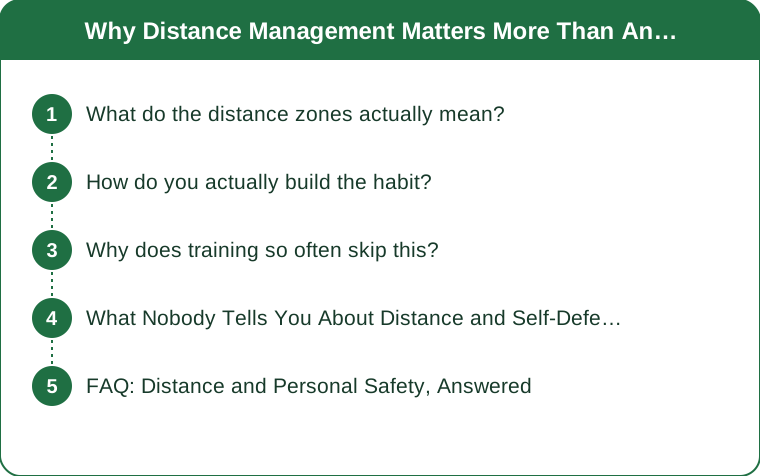
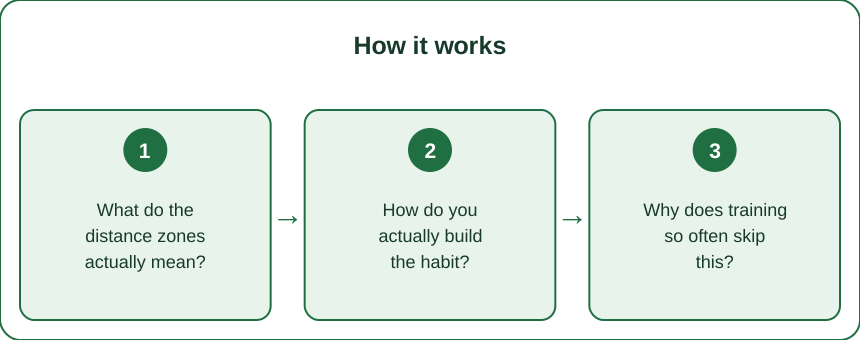
What do the distance zones actually mean?
Three practical zones, each defining a different set of available options.
Beyond about three metres: everything is available. You can leave, change direction, cross the road, enter a shop, or make a phone call. No physical skill is required and nothing has been committed to. The overwhelming majority of situations should be resolved here.
Two arm lengths, roughly 1.5 to 2 metres: the decision zone. Someone at this distance can close on you in under a second. You still have options but the window is closing, and this is where verbal boundary-setting and repositioning belong.
Within one arm length: contact range. Almost all of your options are now physical and close-range. Everything is faster, more chaotic, and more dependent on whatever you can do under a full adrenaline response, which is considerably less than what you can do in a class.
The zones matter because your capability drops sharply as they close. Fine motor skills degrade under adrenaline, vision narrows, and complex decisions become very difficult. A technique that works in the third zone in training frequently does not under real stress.
So the entire strategic goal is to resolve things in the first zone. Not because the other zones do not matter, but because your success probability there is enormously higher and requires nothing of you physically.
And this is trainable without any athleticism. Noticing distance is a perceptual habit. It is available to anyone regardless of size, strength, age, or mobility, which is why it belongs at the front of any honest self-defense curriculum.
How do you actually build the habit?
By practising in ordinary situations where nothing is at stake, which is the only way a habit becomes automatic.
Set a distance number and check it periodically. Walking anywhere, occasionally ask yourself who is closest and how far away. Not with alarm; as a neutral observation. The point is to make the question automatic.
Practise repositioning as a default response. When someone approaches, step or angle so you have space and an exit path. Do this in queues, at ATMs, on platforms. It is invisible to everyone else and it builds the motor habit.
Notice your own exits everywhere you go. Where would you go from here. This takes two seconds and, done consistently for a few weeks, becomes something you do without effort.
Keep your hands free and your attention available. Both hands full and both ears occupied removes your ability to notice and to act. This is not about paranoia; it is about not voluntarily giving up options.
Practise the early verbal boundary. A clear, loud, simple sentence at two arm lengths, delivered before anything has happened, is enormously more effective than anything you say once contact has been made. It also feels awkward, which is exactly why it needs practice rather than just knowledge.
And rehearse the leaving. Most people have never practised simply turning around and walking the other way, and social discomfort about doing so is the single most common reason people stay in a closing situation. Practising the act of leaving lowers that barrier.

Why does training so often skip this?
Because it is not visually interesting and because it is hard to sell, and both of those are worth naming.
Techniques demonstrate well and distance management does not. A wrist release looks like something. Crossing the street looks like nothing. This creates a systematic bias in what gets taught and what gets filmed.
A cooperative partner starts at contact range because that is where the technique lives. Beginning every drill at contact range trains you to begin at contact range, which quietly teaches that the earlier phase is not where the work happens.
Adrenaline effects rarely get simulated. In class you are calm, warm, and expecting the attack. Under real stress, heart rate spikes, fine motor control degrades, peripheral vision narrows, and complex sequences become unavailable. Techniques that require precision are the first to go.
Which is why the simplest options survive. Gross motor movements, loud voice, and running are the things that remain available under a full stress response, and all three are more effective from distance than from contact.
Good instruction does cover this. Look for classes that spend time on awareness, verbal boundary-setting, and de-escalation, and that run scenarios starting at realistic distances rather than at arm’s length.
And a class that never lets you fail is not testing anything. Practising exclusively against a partner who cooperates produces confidence without capability, which is a worse outcome than no training at all.
What Nobody Tells You About Distance and Self-Defense
Leaving early feels rude, and that feeling is the main obstacle. Almost everyone can identify the moment they felt uneasy and stayed anyway. The barrier is social, not physical, and recognising it as a social barrier is what makes it possible to override.
Most people notice something is wrong well before anything happens. The recurring theme in accounts afterward is that the feeling was there and got talked out of. Treating that feeling as information rather than as rudeness is a genuine skill.
Distance is not just physical space, it is time. Every extra metre is time to see, decide, and act. Under adrenaline, decisions take considerably longer than they do calmly, which makes that time worth more than it looks.
Your legs stay functional when your hands do not. Under a strong stress response, fine motor skills degrade first while gross motor movement remains. This is precisely why moving away is more reliable than any hand technique.
Voice is a distance tool and it fails if you have never used it loudly. Most people have never shouted in their adult lives. A voice that has never been used at volume tends not to work the first time it is needed, and practising it out loud, awkward as that is, genuinely helps.
And this is general safety information, not training. Nothing written can substitute for practising with qualified instruction, and any specific situation involving threats or violence warrants contacting the appropriate authorities and support services rather than self-management.
FAQ: Distance and Personal Safety, Answered
What is the most important self-defense skill?
Noticing and managing distance. Beyond about three metres you retain every option including leaving, and no physical ability is required. Inside one arm length, your options collapse and your capability drops sharply under adrenaline.
How much space should you keep from a stranger?
At least two arm lengths, roughly 1.5 to 2 metres, in any situation where you feel uncertain. Someone at that distance still needs about a second to reach you, which is enough time to act.
Why do techniques that work in class fail under stress?
Adrenaline degrades fine motor control, narrows vision, and makes complex decisions difficult. Gross motor movements, loud voice, and running remain available. All three work better from distance than from contact range.
TL;DR:
- Distance determines what is possible for both people. Beyond three metres you have every option; inside one arm length you have very few.
- The skill is noticing distance closing early, which is a perceptual habit requiring no physical ability at all.
- Practise in ordinary settings: check who is closest, reposition in queues, note exits, keep hands and attention free.
- Under adrenaline, fine motor skills go first while legs and voice remain. Both work better from distance.
Leaving early feels rude, and that social discomfort is the main obstacle. Naming it is what lets you override it.
Keep Reading
This article is for general informational and styling purposes only. Fit, sizing, and product availability may vary.