Why Most Self-Defense Classes Teach the Wrong First Move for a Real Encounter
Quick Answer: Most self-defense classes lead with physical technique (strikes, escapes, holds), but the actual most important first move in a real encounter is creating distance and space — physical technique matters far less if you’re already too close, which is why distance-and-escape drills deserve more class time than they typically get.

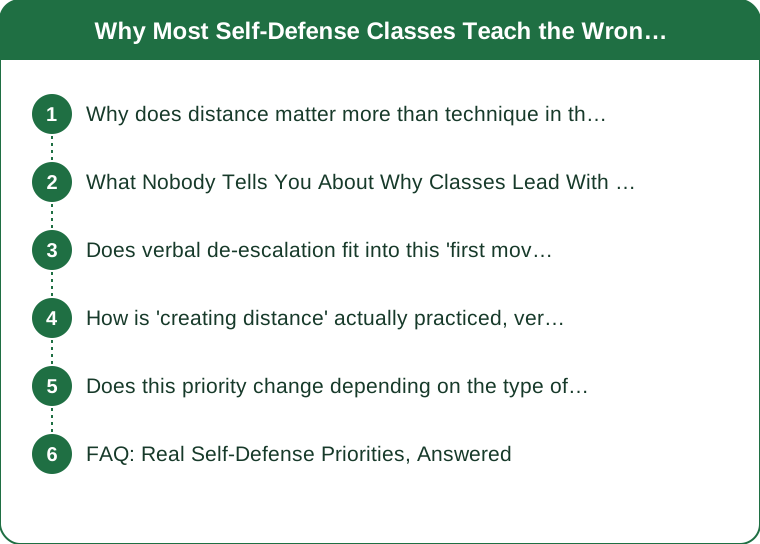
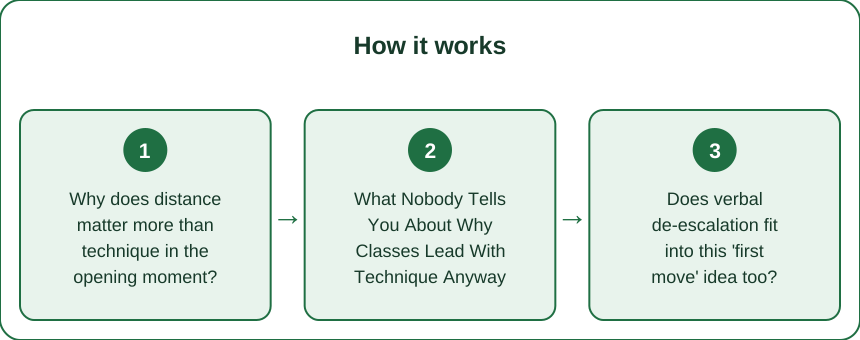
Why does distance matter more than technique in the opening moment?
Every physical technique becomes both more effective and safer to attempt from a greater distance — a strike, an escape, or simply running all work better with space to react, while the same options become much harder once someone is already too close, which is exactly the moment most curriculum starts teaching from.
What Nobody Tells You About Why Classes Lead With Technique Anyway
Physical technique is easier to demonstrate, teach, and measure progress on in a structured class setting than the more instinctive, situational skill of creating distance early — this is partly a teaching-convenience issue, not necessarily a reflection of what matters most in a real scenario.
Does verbal de-escalation fit into this ‘first move’ idea too?
Yes — a firm verbal response combined with immediately increasing physical distance often defuses or interrupts a situation before it reaches the point where physical technique becomes necessary at all, making it a genuine first-line response rather than a separate, secondary skill.

How is ‘creating distance’ actually practiced, versus just discussed?
Effective distance drills involve practicing rapid backward or lateral movement while maintaining balance and awareness, not just standing still and being told the concept matters — the actual physical habit needs repetition the same way a strike technique does.
Does this priority change depending on the type of threat?
Somewhat — a threat involving a weapon makes creating distance even more critical relative to physical technique, since closing that gap with hand-to-hand technique against an armed threat is far riskier than against an unarmed one, reinforcing why distance is the priority regardless of scenario type.
FAQ: Real Self-Defense Priorities, Answered
Does this mean physical technique isn’t worth learning at all?
No — physical technique remains valuable as a backup when distance and de-escalation aren’t possible, it’s a matter of correct prioritization and class time allocation, not replacement.
How can someone evaluate whether a self-defense class actually teaches this priority?
Asking directly whether the curriculum includes distance and awareness drills, not just strikes and holds, is a reasonable way to gauge whether a class reflects this broader priority.
Is awareness training a separate skill from distance-creation, or connected?
They’re closely connected — awareness is what allows distance-creation to happen early enough to matter, so the two are often taught together for good reason.
TL;DR:
- Distance and space matter more in the opening moment than physical technique
- Classes often lead with technique because it’s easier to teach, not because it matters most
- Verbal de-escalation paired with increasing distance can defuse situations before technique is needed
- Distance-creation is a practiced physical habit, not just a concept to understand
Physical technique still has real value as backup — but the actual first move worth prioritizing is getting space, not getting into position to strike.
Keep Reading
This article is for general informational and styling purposes only. Fit, sizing, and product availability may vary.