Why Practicing Self-Defense Only Against a Cooperative Partner Doesn't Prepare You
Quick Answer: Drilling techniques against a partner who releases on cue builds muscle memory for a scenario that won’t resist you the way a real attacker would. Adding resistance and unpredictability to at least some practice closes that gap.
Your wrist-grab escape looks flawless in class. Your partner grabs, you execute the technique, they let go right on schedule. That drill teaches your body the motion — but it doesn’t teach you what happens when the grip doesn’t release, the attacker adjusts, or the whole thing happens faster and messier than a controlled repetition.

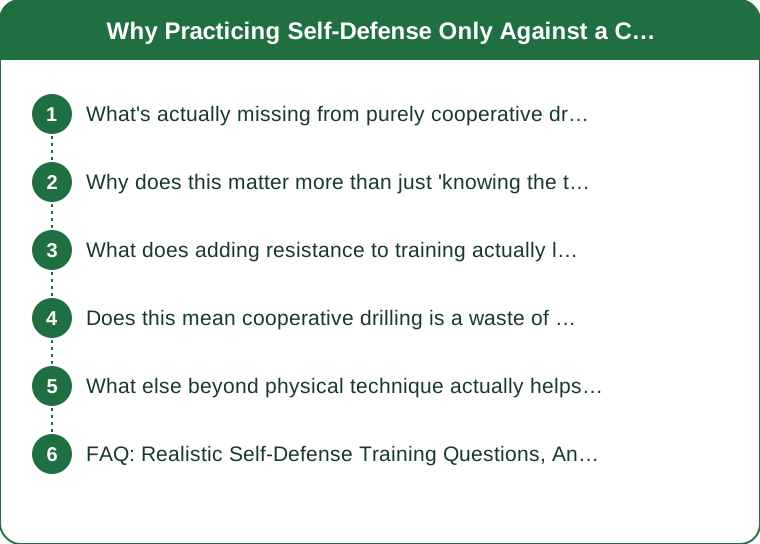
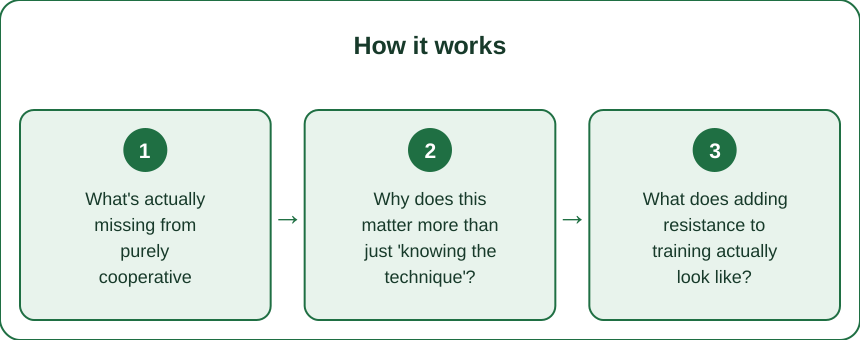
What’s actually missing from purely cooperative drilling?
Resistance and unpredictability. A cooperative partner gives you a clean, single-variable rehearsal — grab, technique, release. Real situations involve a moving, resisting, adapting opponent, and your body has never practiced adjusting to that variability if every rep looked the same.
Why does this matter more than just ‘knowing the technique’?
Under real stress, people default to what they’ve drilled most, including the unconscious assumption baked into cooperative practice that a grip will release on cue. If it doesn’t (because a real attacker won’t cooperate), that mismatch between expectation and reality can cause a dangerous freeze in the moment it matters most.
What does adding resistance to training actually look like?
Start light: a partner who holds on for 2-3 seconds after the grab instead of releasing instantly, forcing you to actually generate the leverage the technique requires rather than relying on their cooperation. Progress gradually to full resistance drills, ideally with padded gear, under qualified instruction.

Does this mean cooperative drilling is a waste of time?
No — cooperative repetition is exactly right for learning the initial mechanics and building the motor pattern. The mistake is stopping there and assuming the skill transfers automatically to a resisting, unpredictable situation without ever practicing that harder version.
What else beyond physical technique actually helps in real situations?
Situational awareness and verbal de-escalation prevent far more incidents than any physical technique ever gets used for — the physical skill matters, but it’s one layer in a system that starts with awareness and avoidance long before contact happens.
FAQ: Realistic Self-Defense Training Questions, Answered
Is resistance training riskier for injury?
Slightly, which is why gradual progression under a qualified instructor with proper padding matters — don’t jump straight to full-resistance sparring without building up to it.
How often should resistance drills be part of training?
Even occasional resistance-based sessions (once every few weeks) meaningfully improve real-world readiness compared to purely cooperative practice alone.
Does adrenaline change how techniques perform in real situations?
Yes significantly — stress hormones affect fine motor control, which is another reason gross, simple techniques practiced under some resistance tend to hold up better than complex ones only ever drilled cooperatively.
TL;DR:
- Cooperative-only drilling teaches the motion but not how to handle real resistance or unpredictability
- A grip that doesn’t release on cue can cause a dangerous freeze if you’ve never practiced that mismatch
- Add graduated resistance to some training sessions, under qualified instruction
- Situational awareness and de-escalation prevent more incidents than physical technique alone
Cooperative drilling builds the foundation — resistance training is what makes it actually usable.
Keep Reading
This article is for general informational and styling purposes only. Fit, sizing, and product availability may vary.