Why Practicing Self-Defense Only Against a Cooperative Partner Fails You in a Real Moment
Quick Answer: Practicing only against a partner who moves slowly and predictably trains your body for a scenario that doesn’t resemble a real, resisting attacker — the technique works in class because the partner cooperates with it. Add resistance and unpredictability gradually, or the skill won’t transfer under real stress.
You’ve practiced the wrist-grab escape dozens of times, and it works flawlessly every time — because your partner grabs your wrist the same way, at the same speed, and doesn’t resist the escape. That predictability is exactly why the skill might not show up the one time you actually need it.

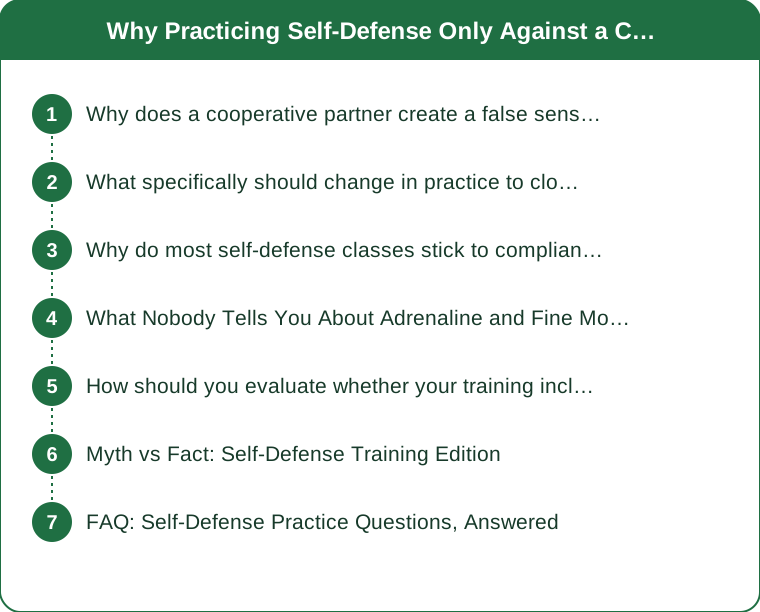
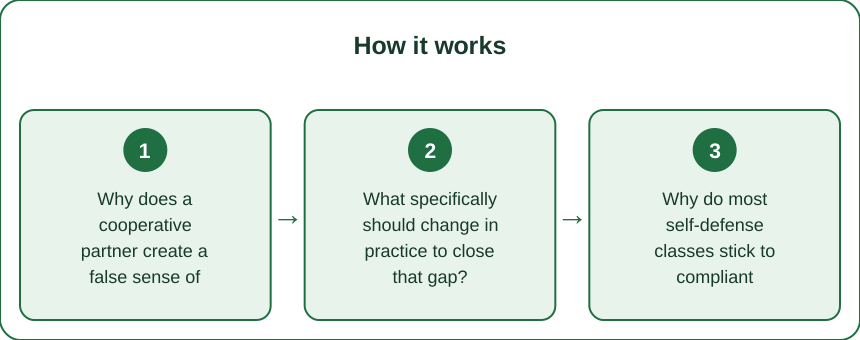
Why does a cooperative partner create a false sense of readiness?
Training against a compliant partner teaches the motor pattern of a technique — the sequence of movements — but it doesn’t train your nervous system to execute that pattern under the adrenaline, tunnel vision, and unpredictable resistance of a real situation. Under real stress, fine motor skills degrade and reaction time changes; a technique drilled only in calm, predictable conditions hasn’t been tested against either of those realities.
This is a well-documented gap in self-defense training broadly — the technique ‘works’ in the dojo because the conditions of the dojo are fundamentally different from the conditions of an actual threat.
What specifically should change in practice to close that gap?
Graduated resistance, introduced in stages: first the partner adds mild, then moderate resistance to the grab or hold (not full-strength, which risks injury in practice), then variable timing so you don’t know exactly when the grab is coming, then eventually scenario-based practice with some genuine unpredictability, ideally with a qualified instructor overseeing safety.
The goal isn’t to simulate a full real attack in every session — it’s to make sure the technique still works when the conditions aren’t perfectly cooperative, which is the actual test that matters.
Why do most self-defense classes stick to compliant practice?
Partly for safety (full resistance practice carries real injury risk without careful progression and supervision), and partly because compliant practice is simply easier to teach and demonstrate cleanly. There’s nothing wrong with starting there — it’s the right way to learn the initial motor pattern. The problem is when a program stays there indefinitely and never progresses to any resistance at all.

What Nobody Tells You About Adrenaline and Fine Motor Skills
Here’s the part rarely discussed openly: under genuine fear or adrenaline, fine motor control — the kind needed for a precise wrist-lock or a specific finger position — degrades significantly, while gross motor movements (a strong push, a knee strike, running) remain far more reliable. This is why many self-defense approaches shift emphasis toward simpler, gross-motor techniques for real unpredictable situations, even if precise techniques look more impressive in a calm demonstration.
How should you evaluate whether your training includes enough resistance?
Ask directly: does your class ever include partner resistance, even mild, or timing variability? If every single technique is practiced against a partner who grabs the same way, at the same speed, and lets go the moment you start the counter-move every time, that’s a signal the training hasn’t progressed past the first stage — worth raising with an instructor or supplementing elsewhere.
Myth vs Fact: Self-Defense Training Edition
Myth: If a technique works against a cooperative partner, it’ll work in a real situation. Fact: Compliant-partner success only confirms the motor pattern is learned — it says nothing about performance under resistance, adrenaline, or surprise.
Myth: More techniques memorized equals better real-world readiness. Fact: A smaller number of gross-motor techniques practiced under some resistance tends to transfer better than a large number of precise techniques only ever practiced compliantly.
Myth: Confidence from class means the skill will hold up under real stress. Fact: Confidence built entirely on compliant practice can actually be a liability if it isn’t tested against any resistance before it’s needed for real.
FAQ: Self-Defense Practice Questions, Answered
Is it dangerous to add resistance to self-defense practice?
It requires careful, gradual progression and ideally qualified supervision — jumping straight to full resistance without building up is where injury risk comes from, not resistance itself.
Should beginners skip compliant practice and go straight to resistance?
No — compliant practice is the correct first step to learn the pattern; the mistake is stopping there permanently rather than progressing.
How can I add some resistance practice on my own outside of class?
With a trusted, willing partner, start with mild resistance and slower speed, focusing on whether the technique still works at all under any pushback, before increasing intensity gradually.
TL;DR:
- Compliant-partner practice teaches the motor pattern but not performance under real resistance or stress
- Gradually add resistance and unpredictable timing, ideally with supervision, to actually test techniques
- Under adrenaline, gross-motor moves tend to hold up better than precise fine-motor techniques
- Confidence from calm practice alone can be a false sense of readiness
Ask at your next class whether resistance training is part of the progression — and if it isn’t, that’s worth raising directly with your instructor.
Keep Reading
This article is for general informational and styling purposes only. Fit, sizing, and product availability may vary.