Why Situational Awareness Fails Exactly When You Need It Most
Quick Answer: Situational awareness is usually taught as a matter of will — stay alert, look around, be present. But attention is a limited resource that depletes with fatigue, stress, and cognitive load, and it fails most reliably at the end of a long day, when you are worried about something, or when you are on a familiar route. The practical answer is not trying harder. It is building habits and environmental defaults that work without requiring sustained attention.
Design for the version of you that is tired, not the alert one.

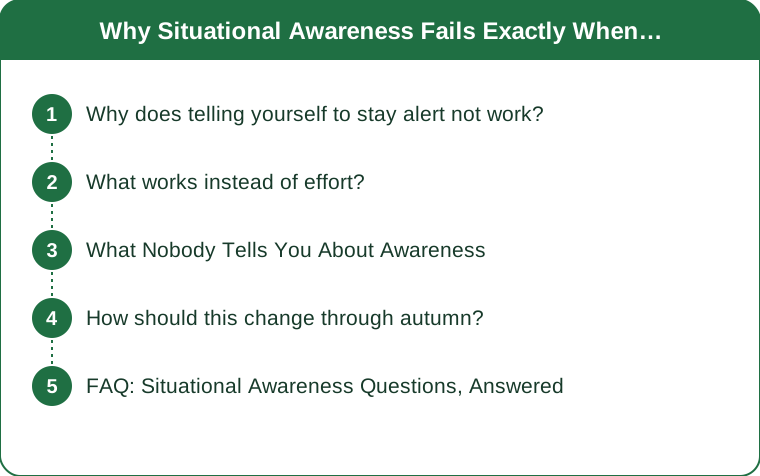
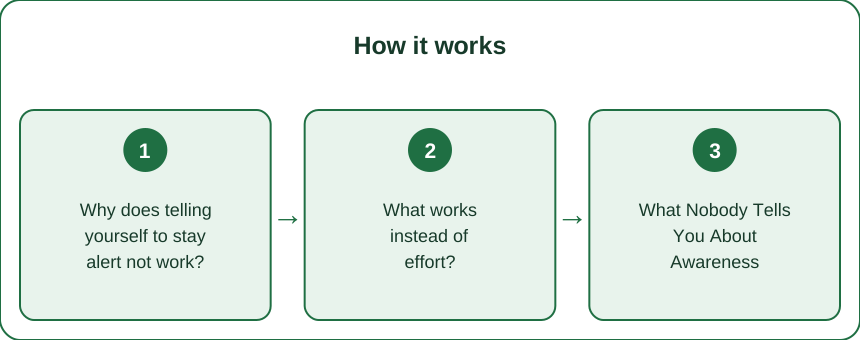
Why does telling yourself to stay alert not work?
Because sustained vigilance is a known limitation of human attention, and it has been studied for decades.
Vigilance research consistently shows that the ability to maintain attention on monitoring tasks declines measurably over time. This is not a character flaw or a training gap; it is a property of how attention works. Performance on watch-keeping tasks drops within tens of minutes, and no amount of motivation fully prevents it.
Several factors accelerate the decline.
Cognitive load. If you are thinking about a difficult conversation or planning tomorrow, that occupies the resource. You cannot fully attend to your surroundings and fully process something else simultaneously.
Fatigue. Attention is more expensive when tired, and end-of-day is when many people are moving through the environments they would most want to be alert in.
Familiarity. Your brain filters predictable environments aggressively. A route you walk daily generates less conscious processing than a new one, which is efficient and is why people arrive home with no memory of the journey.
Stress. Anxiety narrows attention rather than broadening it. Someone who is worried is often less aware of their surroundings, not more, because their attention is turned inward.
The conclusion is not that awareness is hopeless. It is that awareness built on effort alone is unreliable, and reliability is the whole point.
What works instead of effort?
Structure — decisions made in advance, so they do not require attention in the moment.
The principle is the same one used in aviation and medicine: when attention is unreliable, replace judgment in the moment with a decision made beforehand.
Choose routes once, deliberately, when you are calm. Sit down and decide which way you walk home in the dark. Consider lighting, foot traffic, and where the open businesses are. Then default to that route without re-evaluating each time. A good route chosen once beats a route chosen freshly each night by a tired person.
Set rules rather than making calls. Phone in the pocket from the station to the door. Headphones out after dark, or one ear only. Keys retrieved before leaving the building. Rules do not consume attention; judgments do.
Reduce the cognitive load at the vulnerable moment. The transitions — arriving, leaving, unlocking a door, getting into a car — are where load is highest, because you are handling objects and thinking about what comes next. Do the fiddly things before you get there, so the transition itself is fast.
Use the environment. Walking on the side of the street with more light, more open businesses, and more people is a decision that requires no ongoing attention once it is a habit.
None of this requires being alert. That is precisely the point.
What Nobody Tells You About Awareness
The goal is not constant vigilance; it is a low baseline plus a working alarm. Trying to be highly alert all the time is exhausting and unsustainable, and it degrades. A relaxed but externally-oriented default, with an intact ability to notice something wrong, is both achievable and more effective.
Your intuition is a genuine detection system, and stress degrades it. The sense that something is off is often pattern recognition operating faster than conscious thought. It works better when you are calm — which is another argument against trying to maintain artificial high alert.
Headphones are less of a problem than phones. Audio removes one channel; looking at a screen removes vision, attention, and posture simultaneously, and it also visibly signals distraction. If you keep one habit, keep your eyes up.
Familiar routes are where awareness is lowest. People are careful in unfamiliar places and switch off close to home. That inversion is worth knowing about yourself.
Looking aware matters independently of being aware. Head up, steady pace, scanning occasionally. This is about how you are perceived as a potential target, and it costs nothing.
Fatigue is the biggest predictor of a lapse. If you know you will be exhausted, that is when the pre-made decisions matter most — and when it is most worth taking the better-lit route even if it is longer.
How should this change through autumn?
Substantially, and the change arrives faster than most people adjust to.
Darkness arrives earlier every week, and the rate of change is fastest right now. A journey that was in daylight in August is in dusk by late September and full dark by late October. The environment changes while your habits do not, which is the gap worth closing deliberately.
Specific adjustments for the season:
Re-choose your routes for darkness. A route selected for a summer evening may run through a park or a quiet stretch that was fine in daylight and is a different proposition at seven in the evening. Do this now, before you need it, rather than making the call while standing at a junction in the dark.
Move regular activities earlier where you can. An evening run or walk that was comfortably in daylight will not be in a few weeks. Shifting it earlier is easier than adapting to doing it in the dark.
Check your lighting assumptions. The streetlights on your route may not be where you remember, and some may not work. Worth noticing on a walk you take deliberately rather than discovering when it matters.
Account for weather. Rain and wind reduce both your awareness and other people’s — hoods restrict peripheral vision, rain reduces visibility and hearing, and everyone is looking down. A wet dark evening is the lowest-awareness environment of the year, and it is worth having pre-made decisions in place for it.
Tell someone your route for anything unusual. Not paranoia; just the standard practice that costs one message.
This is general information about personal safety habits, not tactical or legal advice. Local circumstances vary considerably, and if you have specific concerns about your safety, local resources and professionals are better placed to advise than any general article.
FAQ: Situational Awareness Questions, Answered
Is it bad to wear headphones when walking alone?
It removes one information channel, which matters more at night and in quieter areas. One earbud, or transparency mode, keeps most of the benefit. It is a smaller factor than looking at your phone.
How do I stay aware without feeling anxious all the time?
By replacing vigilance with structure. Pre-decided routes and habits mean you do not have to be assessing continuously, which is both more effective and considerably less draining. Anxiety and awareness are not the same thing, and high anxiety usually reduces awareness.
What should I actually be looking for?
Not specific threats, which is a poor use of attention. Look for the general shape of your environment — where people are, where the exits and open businesses are, what is behind you occasionally. Noticing something that does not fit is what your pattern recognition does, and it needs the general picture to work from.
Does carrying something for protection help?
That is a personal decision with legal implications that vary by location, and it is worth noting that any tool requires being aware enough to use it — which brings you back to the same question. Awareness and avoidance do more work than any object.
TL;DR:
- Sustained vigilance reliably degrades with time, fatigue, stress, and familiarity — awareness built on effort alone fails when you need it.
- Replace in-the-moment judgment with decisions made in advance: chosen routes, fixed rules, keys out before you get there.
- Aim for a relaxed, externally-oriented baseline rather than constant high alert, which is unsustainable and degrades intuition.
- Darkness is arriving earlier every week right now — re-choose your routes for dark conditions before you need them.
Spend ten minutes this week deciding your dark-evening route home. That decision, made calmly, outperforms any amount of trying harder later.
Keep Reading
This article is for general informational and styling purposes only. Fit, sizing, and product availability may vary.