Why Where You Carry Your Bag Decides How Fast You Can React
Quick Answer: Whatever is in your hands is what your hands are doing when something starts. A bag carried on the forearm, a phone in your dominant hand, and a coffee in the other means you have zero free hands and a two-second delay before you have one. Carrying decisions are made hours in advance and they set your reaction time before you ever see a threat - which makes bag position one of the highest-value, lowest-effort safety habits there is.
This is not about clutching your bag defensively. It is about not spending your hands before you need them.

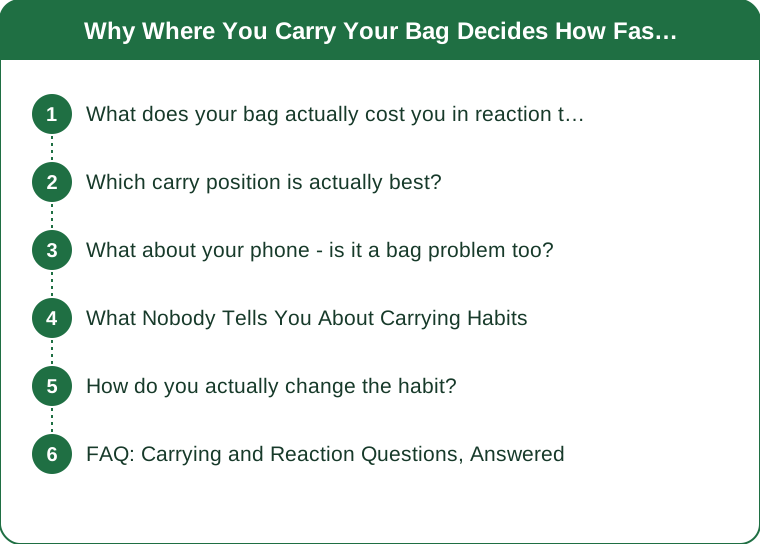
What does your bag actually cost you in reaction time?
Dropping something is not instant. The decision to release a bag you are holding takes a fraction of a second on its own - and most people do not drop it at all. They hold on, because it contains their phone, keys, wallet, and everything else that makes the next hour of their life work.
That hesitation is the whole problem. In the first two seconds of anything sudden, you either have a hand available or you do not. A shoulder bag that slides down your arm as you move produces a grab reflex - your hand goes to the strap, not to what is in front of you.
A forearm-carried bag is the worst case. It occupies one arm completely, unbalances your gait, and cannot be shed quickly. A crossbody worn across the torso is the best case - it stays put without any hand involvement at all, leaving both hands genuinely free.
And the difference compounds with what else you are holding. Phone in one hand, bag on the other arm, and you are functionally carrying two objects and paying attention to a third. Awareness and hand availability fail together, not separately.
The useful mental model is simple. Ask, walking out of the door: if I needed both hands right now, how long would it take me to get them? If the answer is more than half a second, change something.
Which carry position is actually best?
Crossbody, worn in front of the hip, is the strongest all-round choice. The strap distributes across your torso, the bag cannot slip off a shoulder, and neither hand is committed. It also keeps the bag within your field of vision rather than trailing behind you.
Single-shoulder is the most common and the weakest. The bag slides, so your hand goes up to steady it, so one hand is semi-committed almost continuously without you noticing. On a crowded train or busy pavement, that becomes a permanent hand occupation.
A backpack frees both hands but costs you awareness of the bag itself. Everything in it is behind you and outside your vision. For hand availability it is excellent; for contents security in a crowd it is the weakest - which is why the front-carry in dense crowds exists.
A wristlet or clutch commits a hand completely and is the reason so many people end up walking with nothing available. If you use one, put it inside something else for transit and take it out when you arrive.
Position matters as much as type. A crossbody worn with the bag swung round to your back gives you the same hand freedom but none of the visibility. Bag in front, strap across, hand free. That is the configuration.
One practical caution about anti-theft straps. A slash-resistant, non-adjustable strap worn across the body is excellent against snatching and exactly wrong if you ever need to shed the bag fast. Know which trade-off you have chosen rather than discovering it in the moment.
What about your phone - is it a bag problem too?
The phone is the bigger hand thief, and it costs you attention as well as a hand. Walking with a phone in your dominant hand is the single most common way people arrive at a situation with nothing free.
Your dominant hand is the one you want available. It is faster, stronger, and more coordinated. If you must carry something in a hand, put it in the non-dominant one - this is the smallest possible change with the largest reduction in delay.
Pocket over hand, always, when you are moving. A phone in a jacket pocket is retrievable in under a second and costs nothing while it is there. A phone in your hand is a phone you will look at.
Headphone volume belongs in the same conversation. Both ears at high volume removes the sense that gives you the earliest warning. One earbud, or transparency mode, keeps the direction-finding your hearing provides - and direction is what lets you move correctly rather than just quickly.
And handle the transitions deliberately. Leaving a shop, getting out of a car, walking to a door: those are the moments people are holding the most. Consolidate before you move, not while you are moving.

What Nobody Tells You About Carrying Habits
The habit is set at the door, not on the street. By the time you are in a car park at 9pm, your hands are already allocated. All the useful decisions were made when you picked up your things - which means the only place to change anything is at the start.
Autumn changes everything about this, and it changes fast. As it gets dark earlier, the same 5:30pm walk that was a bright-daylight route in July becomes a dusk route in October. Your carrying habits do not update on their own - they were built in summer conditions and quietly become wrong.
Gloves are the seasonal detail nobody accounts for. Thick gloves reduce grip and dexterity substantially and make retrieving anything from a pocket slower. If you carry a personal alarm, test it wearing winter gloves - many people discover in January that they cannot operate theirs at all.
Shopping bags are the genuinely unavoidable case. You cannot carry groceries hands-free. What you can do is choose the moment - not the walk to a badly lit car at night, not both hands loaded for a long stretch. Two trips is a legitimate safety decision, not an inconvenience.
And the goal is not paranoia; it is not paying a cost for nothing. Walking with free hands costs you literally nothing on the 999 days when nothing happens. That is what makes it worth doing - the habit is free.
How do you actually change the habit?
Change the equipment, not the willpower. Habits that rely on remembering fail; habits enforced by what you own do not. Buying a crossbody with an adjustable strap does more than any number of reminders.
Run one week of noticing. For seven days, just observe what is in your hands when you leave anywhere. Do not change anything yet - most people are surprised, and the surprise is what produces the change.
Set a single default and apply it everywhere. Mine can be yours: bag crossbody in front, phone in pocket, dominant hand empty. One rule beats a decision tree you will not run under pressure.
Practice the shed. If you use a crossbody, know whether it comes off over your head in one motion, and try it once. Discovering that it does not while something is happening is the wrong time to find out.
Check the alarm placement against the carry. A personal alarm at the bottom of a bag is decorative. Clip it where the hand you keep free can reach it - and re-check that when you change bags or coats, which is when placement quietly breaks.
And re-run this at each season change. Autumn and spring both change what you wear, what you carry, and how dark your usual routes are. Twice a year is enough to keep the habit matched to the conditions.
FAQ: Carrying and Reaction Questions, Answered
Is a crossbody bag really safer than a shoulder bag?
For hand availability, clearly yes - it stays put without a hand steadying it. Just wear it in front rather than swung round to your back, so it stays in your field of view.
Should I hold my keys between my fingers when walking?
It is a widely repeated idea with real drawbacks: it commits a hand, is more likely to injure you than anyone else, and can prevent you from using the keys to get through a door quickly. Keys in hand ready to use are far more useful than keys as a weapon.
What if I have to carry shopping?
Accept that you are hands-committed and choose the timing and route instead. Fewer bags per trip, better-lit routes, and consolidating before you walk are the levers you actually have.
Does a backpack count as hands-free?
Yes for hands, no for awareness of the bag. In crowds, wear it on your front. Walking a quiet street, on your back is fine.
Does any of this matter if nothing ever happens?
The habit costs nothing on every ordinary day, which is what makes it worth having. You are not adding vigilance, you are removing an unnecessary delay.
How often should I review my setup?
Twice a year, at the clock changes. That is when your routes get darker or lighter and what you wear and carry changes anyway.
TL;DR:
- Whatever is in your hands is what your hands are doing. Reaction time is set by carrying decisions made hours earlier.
- Crossbody in front is the strongest carry - it needs no hand at all. Single-shoulder quietly commits one hand permanently.
- Keep the dominant hand empty. If something must be held, it goes in the other one.
- Phone in a pocket, not a hand. It costs a hand and your attention at the same time.
- Change the equipment, not the willpower - a bag that stays put beats remembering to be careful.
- Re-check at each season change, including whether you can operate a personal alarm wearing gloves.
One rule, applied everywhere: bag crossbody in front, phone in pocket, dominant hand free.
Keep Reading
This article is for general informational and styling purposes only. Fit, sizing, and product availability may vary.