Why Your Hands Freeze but Your Legs Still Work Under Threat
Quick Answer: Under a high-adrenaline threat response, fine motor control degrades sharply while gross motor movement is largely preserved or even enhanced. Blood is redirected to large muscle groups, hand tremor increases, and complex sequenced movements become unreliable - but running, pushing, and shouting still work. Build your safety plan around gross motor actions and pre-positioned tools, not around anything requiring finger dexterity. Practise what will still work at 170 beats per minute.
The plan that requires unlocking your phone is not a plan.
Your legs are the most reliable equipment you have.

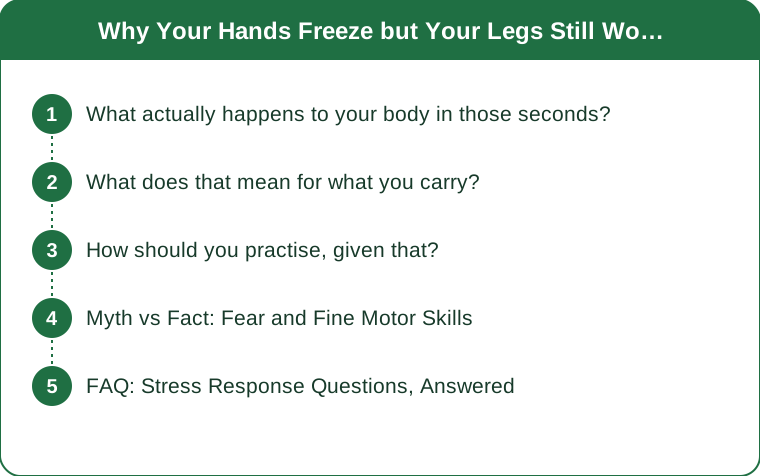
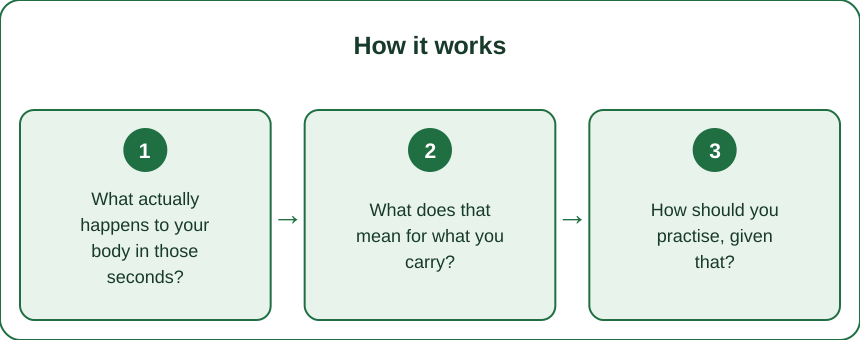
What actually happens to your body in those seconds?
A large, fast physiological shift with predictable effects on movement.
Heart rate rises very quickly under a genuine threat. A sudden adrenaline surge can drive heart rate from resting to well over 150 beats per minute within seconds - far faster than exercise produces, and without the warm-up.
Blood is redirected toward large muscle groups. Peripheral vasoconstriction reduces blood flow to the hands and skin, partly to reduce bleeding from injury. This is why hands go cold and clumsy.
Tremor increases substantially. Adrenaline produces a fine tremor in the hands that makes precise tasks - a key in a lock, a phone passcode, a small clasp - genuinely difficult rather than merely harder.
Vision narrows and changes. Many people report tunnel vision and loss of peripheral awareness under acute stress, and near focus can be affected. Reading a screen is often reported as difficult.
Complex sequenced actions degrade first. Any action requiring several steps in order under time pressure is the most vulnerable - which is precisely what most self-defence tools require.
But gross motor patterns hold up. Running, pushing, pulling, striking with the whole body, and shouting all remain available and are often performed with more force than normal. The system is optimised for exactly these actions.
What does that mean for what you carry?
Anything requiring dexterity has to be pre-positioned, or it is not a tool.
Pepper spray at the bottom of a bag is not a tool. Finding it, orienting it, disengaging a safety, and aiming it involves several fine motor steps under time pressure - the exact category that fails. In hand or on an outside pocket, it becomes plausible.
A personal alarm works because it is a gross motor action. Pull a pin or press a large button - one step, no precision, works with cold shaking hands. This is why alarms outperform more sophisticated tools in real conditions.
Keys between the fingers do not work as most people imagine. They require a specific grip formed in advance and a precise strike, and the mechanics are poor. Keys are far more useful as something to have already in hand for entry, so you are not standing at a door searching a bag.
Your phone is the least reliable tool in the moment. Unlocking, opening an app, and dialling is a multi-step fine motor sequence with a screen your near vision may struggle with. Set up your phone’s emergency call shortcut, which is a hardware button sequence - closer to gross motor.
Your voice is the most reliable tool you carry. Shouting is a gross motor action, requires no equipment, and works at any distance, and it recruits help while making you a less appealing target.
And your legs are the primary tool. Distance solves nearly everything, and running is the single best-preserved capability under adrenaline.

How should you practise, given that?
Train the things that survive, and pre-load the decisions.
Practise gross motor actions only. Palm strikes, shoves, breaking a grip with whole-body movement, and turning and running - all use large muscle groups and simple patterns. Complex joint locks and fine grips are unlikely to be available.
Practise the voice, out loud, at volume. Most people have never shouted at full volume and find it surprisingly hard the first time. A voice that fails is extremely common, and it is trainable in a way that feels awkward and is worth doing anyway.
Make decisions in advance so you are not deciding under stress. Decision-making is impaired under high arousal, so pre-loaded rules - if X happens, I go here - work far better than judgement in the moment. Know where the exits and lit areas are before you need them.
Practise under some physical stress. Doing a technique after thirty seconds of hard effort, with elevated heart rate, is far more realistic than doing it fresh and calm. Any class that only practises at rest is teaching a partial skill.
Practise with a non-compliant partner where it is safe to do so. Techniques that only work on a cooperating partner are not techniques, and this is the most common gap in self-defence instruction.
And build the habits that avoid the situation entirely. Awareness, route choice, keeping hands free, having keys ready - these are all done before adrenaline enters the picture, which is why they are worth far more than any technique.
Myth vs Fact: Fear and Fine Motor Skills
Myth: If you train hard enough, you keep your fine motor skills. Fact: Training reduces the arousal response to familiar situations and improves what you can do at high heart rate, but the physiological effects on hand dexterity are real and do not fully train away. Build a plan that does not need them.
Myth: Freezing means you did something wrong. Fact: Freezing is a normal, involuntary threat response and not a personal failing. Being aware of it and having a pre-loaded action helps you move through it faster.
Myth: Keys between the fingers is an effective weapon. Fact: The grip is difficult to form under stress, the mechanics are weak, and it risks injuring your own hand. Keys are far more useful in hand for fast entry.
Myth: You will remember your training. Fact: You will produce whatever you have practised most, in the simplest form you have practised it. Complex sequences degrade to their simplest components under stress, which is an argument for practising simple things many times.
Myth: A tool in your bag is a tool you have. Fact: A tool you cannot deploy in two seconds with shaking hands is not available to you. Pre-positioning is what turns an object into a tool.
Myth: Shouting draws unwanted attention. Fact: Attention is protective. Making noise is one of the most consistently effective actions available, and it costs nothing to practise.
FAQ: Stress Response Questions, Answered
Can I train myself not to freeze?
Partly. Familiarity with a situation reduces the arousal response, which is the mechanism behind scenario-based training. Pre-loaded decisions also shorten the freeze because you do not have to generate a plan under stress.
Does carrying something make me safer even if I never use it?
Often yes, indirectly. People who carry a personal alarm report walking with more confidence and more awareness, and both of those change how you are perceived. The behavioural effect can be more valuable than the device.
Should I take a self-defence class?
A good one is genuinely useful - look for one that practises under physical stress, uses non-compliant partners, and spends real time on awareness, verbal skills, and de-escalation rather than only physical techniques. The classes that spend the whole session on complex techniques are teaching the least reliable part.
TL;DR:
- Adrenaline degrades fine motor control sharply while preserving gross motor movement - hands fail, legs do not.
- Anything requiring several precise steps is unavailable - pepper spray in a bag, a phone passcode, a small clasp.
- Pre-position tools, use large simple actions, and practise your voice at full volume.
- Pre-load decisions so you are not judging under high arousal.
- Distance solves most situations - running is the best-preserved capability you have.
Set up your phone’s emergency call button shortcut tonight. It is the one phone function that still works with shaking hands.
Keep Reading
This article is for general informational and styling purposes only. Fit, sizing, and product availability may vary.