Why Your Personal Safety Habits Need Rebuilding Every Autumn
Quick Answer: Your safety habits are built around specific conditions — light, foot traffic, visibility, and how easily you can be seen and heard. All four change substantially between August and November while your routes and schedule stay identical. The gap between habits calibrated for daylight and a commute that now happens in darkness is where most people’s planning falls behind.
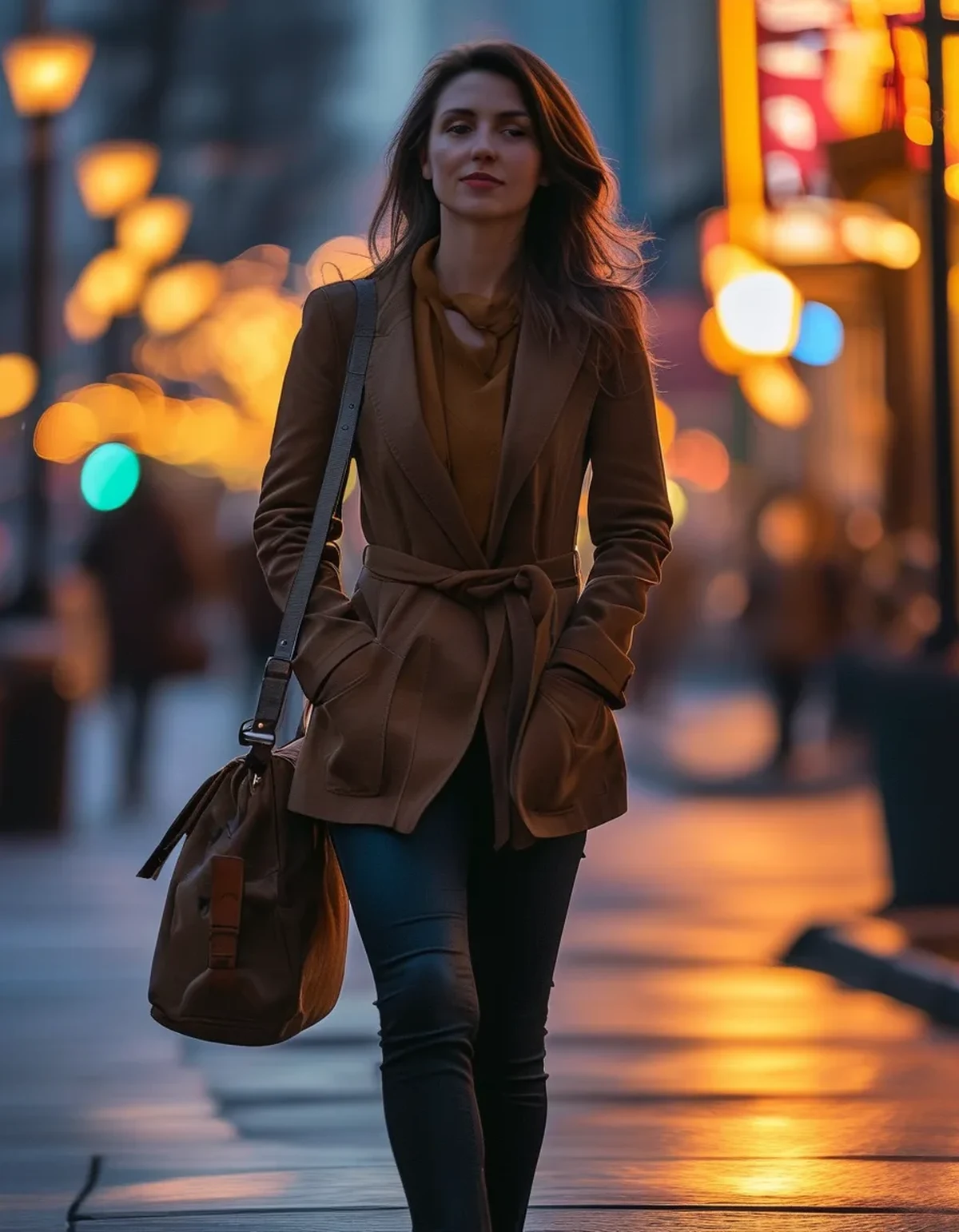
You walk the same route home you have walked all summer. In August it was busy and bright at 6:30pm. By late October it will be dark and half-empty at the same hour, and you will not have consciously decided anything about that.
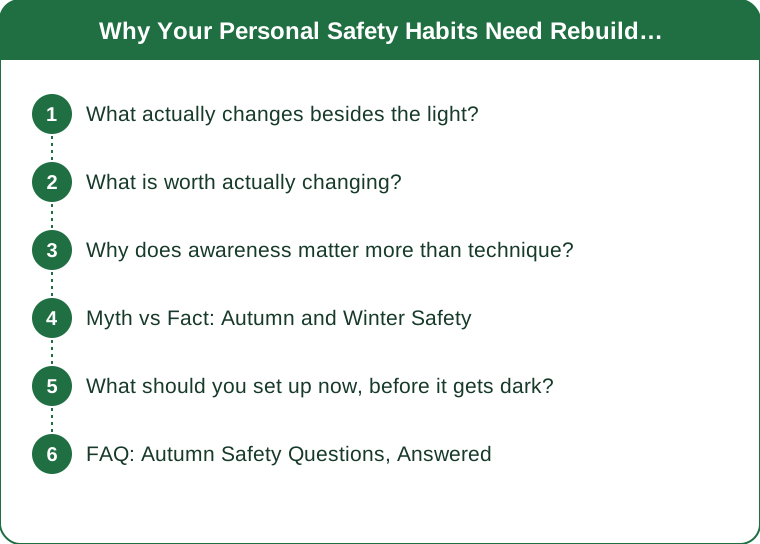
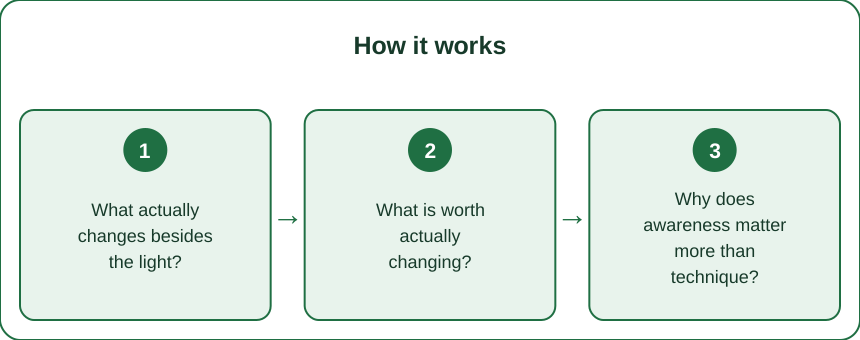
What actually changes besides the light?
Four things, and only the first is obvious.
Visibility, in both directions. You can see less, and you are seen less. Being visible to drivers, cyclists, and other pedestrians is a genuine safety factor that most people only think about in terms of traffic.
Foot traffic thins out. Fewer people are outdoors for recreational reasons once it is cold and dark. The same street at the same time has a substantially different level of passive supervision in November than in August, and that is the change that matters most.
Your own sensory input drops. Hoods, hats, scarves, and headphones under a hat all reduce peripheral vision and hearing. Layering makes you less aware, and it happens gradually enough that you do not notice.
Your movement changes. Cold weather produces hunched posture, hands in pockets, faster walking with head down. Hands in pockets specifically removes your ability to react quickly — to catch yourself falling, to open a door, to use a phone. It is the most consequential winter habit and the least examined.
What is worth actually changing?
A short list of things that are low-effort and hold up.
Re-plan the route for the new conditions, deliberately. Not the shortest route — the one that stays on lit, populated streets. A three-minute detour that keeps you on a main road rather than a quiet shortcut is a good trade and needs to be decided once rather than negotiated each evening.
Keep one ear free. Not necessarily no headphones — one earbud, or bone-conduction, or volume low enough to hear a car. Hearing is the sense you rely on most in low light and the one most easily given away.
Get your hands out of your pockets. Gloves solve this entirely and cost nothing. Hands available means you can react; hands in pockets means you cannot.
Add something reflective or lit. For traffic safety more than anything else, and traffic is the far more common risk. A reflective strip on a bag or a small clip light is genuinely effective.
Tell someone your timing when a route is unusually quiet or late. Low effort, and the thing that shortens response time if anything does go wrong.
Why does awareness matter more than technique?
Because distance and early recognition prevent situations that technique has to resolve.
The consistent theme across personal safety education is that the most useful skills are the ones that operate before anything happens — noticing, choosing a different route, crossing the street, entering a business. These are unglamorous and they are what actually works.
Physical technique matters and it sits at the end of a chain. Everything upstream of it — awareness, distance, positioning, leaving early — is more likely to be useful and far more likely to be available to you under stress.
In autumn the upstream part gets harder for environmental reasons. Less light means less warning time, which means the decisions that depend on early recognition have a narrower window. That is the specific thing worth compensating for.
The practical version: look further ahead than feels necessary. In daylight most people scan a comfortable distance forward without thinking about it. In darkness that distance shrinks on its own, and deliberately extending it — checking the far end of the block, noticing what is at the next corner — restores most of the warning time you lost.
Myth vs Fact: Autumn and Winter Safety
Myth: The risk is mainly about strangers. Fact: In terms of frequency, the largest changes in autumn risk are traffic-related and fall-related. Being hit by a vehicle at dusk and slipping on wet leaves or ice are both far more common than the scenarios people plan for. Visibility and footwear address more actual risk than anything else on the list.
Myth: Carrying something for protection is the main decision. Fact: Whatever you carry is only useful if it is accessible, and in winter it usually is not — buried in a bag, under gloves, inside a coat pocket with a zip. If you carry something, the accessibility question matters far more than the choice of item, and it changes completely once you are wearing a coat.
Myth: You should avoid being out after dark. Fact: By December that means avoiding being out after about 4:30pm in much of the country, which is not a plan anyone can follow. The realistic approach is adjusting how you move rather than whether you go.
Myth: Personal alarms are gimmicks. Fact: They are cheap, they require no skill, they work with cold hands and through gloves, and noise attracts attention. They are one of the more sensible things to carry precisely because they do not depend on you being calm or coordinated.
Myth: Awareness means being anxious. Fact: Awareness reduces anxiety over time, because a person who has already decided their route, their timing, and what they would do feels considerably less uncertain than one who is improvising. Planning is what makes it possible to stop thinking about it.
What should you set up now, before it gets dark?
Doing this in August takes twenty minutes. Doing it in November happens under pressure.
- Walk your regular route once at the time it will be dark, or at least look at it on a map and identify where it goes quiet. Knowing which two blocks are the problem is most of the value
- Decide the alternative route now so it is a default rather than a decision
- Put a small light and something reflective on the bag you actually carry, not the one you might carry
- Sort out gloves, which sounds unrelated and solves the hands-in-pockets problem entirely
- Check that whatever you carry is reachable while wearing a coat. Test it. Most people find it is not
- Set up a check-in habit with someone for the routes that are genuinely quiet, and make it low-friction enough to actually happen
And the framing that makes this worth doing rather than worrying about: this is logistics, not fear. The same category of planning as knowing where your keys are. Twenty minutes now removes a background low-level uncertainty from the next four months, which is a good return on a Sunday afternoon.
One more thing: whatever you set up, use it in September while it is still easy. A habit that is already running by the time the clocks change does not need to be established in the dark.
FAQ: Autumn Safety Questions, Answered
Are personal alarms actually worth carrying?
They are inexpensive, they work regardless of your physical state, and they function with gloves on and cold hands — which is more than can be said for most alternatives. Noise draws attention and attention is genuinely protective. Attach it where you can reach it while wearing a winter coat, which usually means a bag strap rather than inside a pocket.
Should I change my running route in the dark?
Most runners do, and the useful changes are staying on lit routes, running loops rather than out-and-backs so you are never far from a return point, and being visible to traffic. Traffic is by a wide margin the biggest risk for runners in the dark, and reflective gear plus a light addresses most of it.
Is it worth taking a self-defense class?
A good one is genuinely useful, and the value is mostly in what it teaches about distance, awareness, and decision-making under stress rather than in specific techniques. Look for classes that include scenario work and verbal de-escalation rather than only physical drills against a cooperative partner, which is the most common weakness in beginner courses.
TL;DR:
- Light, foot traffic, your own hearing and vision, and your posture all change between August and November
- Hands in pockets and both ears covered are the two habits that cost the most awareness
- Re-plan the route now for dark conditions, and make the alternative a default rather than a decision
- Traffic and falls are the bigger statistical risks — visibility and footwear address more than anything else
None of this is about being afraid. It is the same category of planning as knowing where your keys are, and twenty minutes in August removes a low-level background uncertainty from the whole winter.
Keep Reading
This article is for general informational and styling purposes only. Fit, sizing, and product availability may vary.