Why Your Voice Fails Before Your Hands Do
Quick Answer: Under acute stress the sympathetic response prioritizes gross motor function and suppresses fine motor control — including the fine coordination required for clear, loud, structured speech. That’s why trained people freeze verbally while their hands still work. The fix is the same as for any motor skill: rehearse the specific words out loud, at volume, until they’re retrievable without composition.
Ask anyone who has been through a genuinely threatening moment what they said. A surprising number say nothing at all, or something so quiet it didn’t register. They’d taken the class. Their strikes were fine. Their voice never showed up.

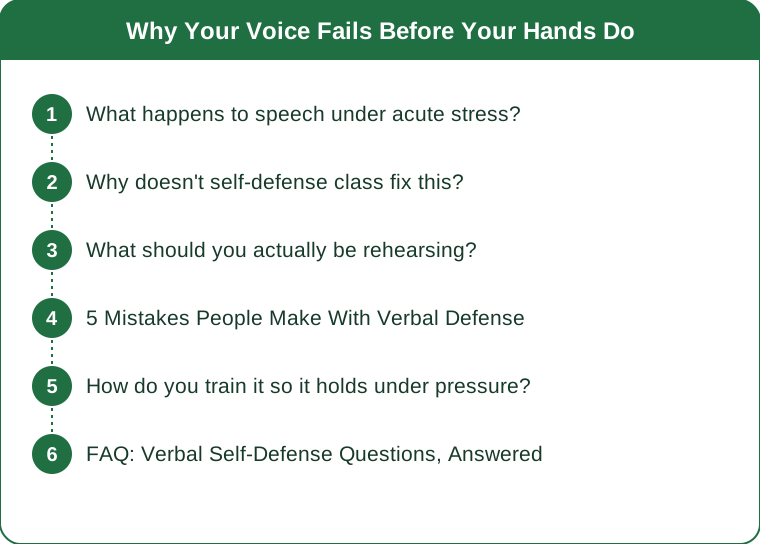
What happens to speech under acute stress?
Speech is a fine motor skill — it takes coordinated control of the diaphragm, larynx, tongue, and lips, plus real-time cognitive work to select words and structure a sentence.
Under sympathetic arousal, heart rate climbs past 115 to 145 beats per minute and fine motor control degrades sharply, while gross motor patterns hold up or even improve. That’s the well-documented pattern: you can shove, you can run, you can swing, but you can’t dial a phone or speak a clean sentence.
Add the cognitive load. Composing an original sentence in the moment requires working memory, which narrows dramatically under threat. You’re being asked to write a script at the exact moment your capacity to write anything is lowest.
So the freeze isn’t a character failure. It’s a predictable consequence of running an unrehearsed fine motor task at peak arousal.
Why doesn’t self-defense class fix this?
Because most classes treat verbal skills as an introduction rather than a drill.
The typical structure: ten minutes at the start on awareness and boundary-setting, discussed conversationally, followed by ninety minutes of physical technique with pads and partners. The physical material gets hundreds of repetitions. The verbal material gets described once.
You can’t build a stress-resistant motor pattern from a description. It requires the same thing every other skill requires — volume, repetition, and practice under arousal.
There’s also a social barrier that pads don’t have. Shouting a boundary at full volume in a room of strangers is genuinely uncomfortable, so classes soften it, and students perform it at conversational volume. Practicing quietly builds a quiet response.
What should you actually be rehearsing?
Short, fixed, retrievable phrases. Three to five words, one breath, no composition required.
The structure that survives stress: a command, not a request. Back up. Stop right there. Don’t come closer. Requests invite negotiation, and negotiation requires cognitive resources you won’t have.
Separately, rehearse a third-party alert — something that recruits bystanders, because generic shouting often doesn’t. Call the police. This man is following me. Specific instructions get acted on; ambiguous noise gets ignored.
And rehearse the mundane one, which is the one you’ll use most: a firm, flat No to a boundary push that isn’t yet dangerous. That’s the version that gets practiced least and needed most.
Pick your phrases now, in calm conditions. Then stop editing them. A phrase you’ve changed six times isn’t rehearsed.

5 Mistakes People Make With Verbal Defense
1. Practicing at conversational volume. If you’ve never said it loud, loud isn’t available to you. Practice at a volume that feels excessive in an empty room.
2. Using a question. Can you please back up? invites a conversation. Back up doesn’t. Under stress the question form also takes more processing to produce.
3. Explaining. I’m sorry, I just don’t feel comfortable because… — every word after the boundary weakens it and consumes time and breath.
4. Waiting for certainty. People stay silent because they’re unsure whether the situation warrants it. The cost of a firm back up when you’re wrong is a moment of awkwardness. The cost of silence when you’re right is much larger.
5. Rehearsing internally. Mentally rehearsing a phrase builds almost none of the motor pattern. The mouth has to make the sound, out loud, repeatedly.
How do you train it so it holds under pressure?
Use the same principle that makes physical technique work: rehearse under progressively higher arousal.
Start alone, at full volume, ten repetitions of each phrase. It’s awkward for about four repetitions and then it isn’t. Do this weekly for a month.
Next, add physical arousal. Do twenty seconds of hard effort — burpees, sprint intervals, anything that pushes your heart rate past 130 — then immediately deliver the phrase at volume. This is the closest most people can safely get to training speech under sympathetic load, and it exposes exactly how much the voice degrades.
Then add a partner who advances toward you while you deliver it. Command plus posture plus distance management, together, because in reality they’re one action rather than three.
If you’re taking a class, ask whether verbal work is drilled under exertion. Programs that do it — often the scenario-based ones — produce noticeably different results than technique-only programs.
FAQ: Verbal Self-Defense Questions, Answered
Doesn’t shouting escalate a situation?
Sometimes, and that’s a real consideration. But a firm, low-pitched command at moderate volume is different from a panicked scream, and it’s the version worth rehearsing. It signals attention and willingness without insult, which is what tends to deter opportunistic approaches.
What if my voice comes out shaky?
That’s normal and it still works. Content and volume matter more than tone. Practicing under exertion reduces the shake over time, but a shaky back up is enormously better than silence.
I freeze even in ordinary confrontations. Is this different?
Same mechanism, lower intensity — and that makes everyday situations excellent practice. Every time you say a clear no to something small, you’re building the retrieval pathway you’d need under pressure. Start there rather than starting at the extreme.
TL;DR:
- Speech is a fine motor skill and degrades under stress exactly when you need it most.
- Most classes describe verbal defense instead of drilling it, so it never becomes retrievable.
- Use short fixed commands, not questions or explanations, and stop editing them.
- Rehearse out loud, at volume, and under elevated heart rate — internal rehearsal doesn’t transfer.
The hands are the easy part to train because hitting a pad feels like training. Saying back up to an empty room at full volume feels ridiculous, which is precisely why almost nobody does it and why so many capable people find, in the moment, that they have nothing to say. Ten repetitions a week, alone, is the whole intervention.
Keep Reading
This article is for general informational and styling purposes only. Fit, sizing, and product availability may vary.