Why Your Voice Is the Most Undertrained Self-Defense Tool You Have
Quick Answer: A loud, firm voice does three things no physical technique can: it interrupts an approach in the selection phase — before contact — it recruits every witness in earshot, and it breaks your own freeze response by giving your body a trained action to perform. Yet almost nobody has ever practiced yelling a boundary at full volume, so under adrenaline the untrained voice comes out quiet, apologetic, or not at all. Social conditioning to be polite is the exact vulnerability a practiced voice removes. Five minutes of actual out-loud rehearsal — real volume, real words — moves the skill from theory into the body, which is the only place it works.
Here is why the voice works, why it fails untrained, and how to train it this week.

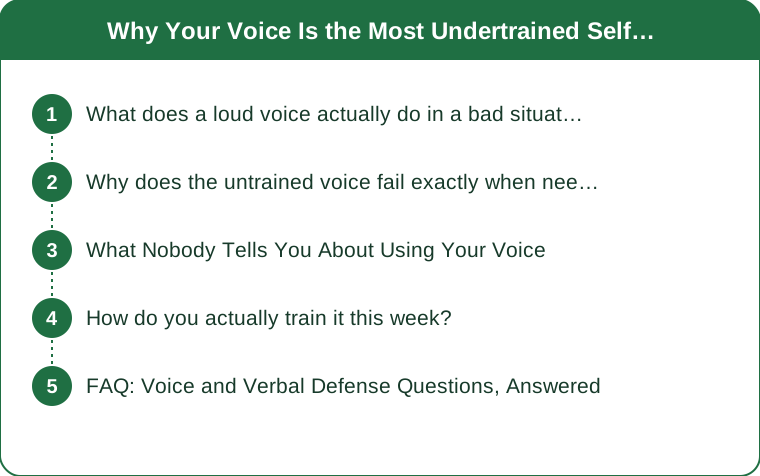
What does a loud voice actually do in a bad situation?
Three jobs, all earlier in the timeline than any physical skill operates.
It fails the interview. People who select targets for harassment or worse overwhelmingly prefer easy ones — distracted, compliant, unlikely to make noise. The early approach is often a test: a too-personal question, a request to move somewhere, an ignored no. A clear, loud, unapologetic response — a firm stop, a flat I said no, delivered at conversation-breaking volume — answers the test with the worst possible result: this person is alert, will resist, and will draw attention. Much of the time, that is the end of the encounter, because the selection logic just failed. The voice wins fights by canceling them at the audition stage.
It recruits the room. Bystanders reliably fail to help when situations are ambiguous — everyone waits for someone else to decide it is serious. A loud, specific voice removes the ambiguity in one second: naming the behavior — back away from me — tells every witness what is happening and that help is wanted. Attention is the one thing an aggressor in a public or semi-public space cannot afford, and your voice is the fastest way to spend it on them.
It unfreezes you. The freeze response is real: under sudden threat, the body often defaults to stillness and silence, especially when no action has been rehearsed. A trained verbal response gives the adrenaline somewhere to go — and the act of producing volume changes your own state: breath moves, posture organizes, the body shifts from prey-still to mobilized. People who train voice work consistently report the same surprise: yelling made them feel capable of everything else.
None of this replaces physical skills, awareness, or leaving early — it precedes them. The voice is the tool for the minute when something is wrong but nothing has happened yet, which is exactly the minute where the best outcomes are still available.
Why does the untrained voice fail exactly when needed?
Because everything about how women are socialized, plus everything about how adrenaline works, points the same direction: quieter.
Politeness is trained deep and triggers automatically. Most women have decades of practice softening refusals — smiling while declining, apologizing while objecting, phrasing boundaries as questions. Under pressure, the brain reaches for its most-rehearsed pattern, and for most people the most-rehearsed pattern is accommodation. The intrusive stranger gets a smiled sorry, I have a boyfriend instead of a flat no, because one of those sentences has been practiced ten thousand times and the other zero. Under stress you do not rise to the occasion; you fall to your training — and most of us have trained apology.
Adrenaline sabotages an unrehearsed voice. Dry mouth, a tight throat, shallow breath — the physiology of fear works directly against volume. People describe trying to yell in a real event and producing a whisper. This is not weakness; it is what happens to any unpracticed motor skill under load. Which is precisely why rehearsal at real volume matters: a voice that has produced a full-force yell before has a groove to fall into when the throat tightens.
The fear of being wrong silences the alarm. The most common reason women override their own discomfort is the thought: what if I am overreacting and embarrass myself? So the discomfort gets managed quietly, the intrusive person gets managed politely, and the situation gets to develop. Here is the reframe worth internalizing: a loud boundary that turns out to be unnecessary costs thirty seconds of awkwardness. The polite version, when the alarm was right, costs far more. The asymmetry only runs one direction, and deciding that in advance — tonight, calmly — is what makes the voice available later.
Add the practical multiplier: earbuds in, eyes on the phone, and the voice never even gets its cue, because the situation is noticed too late for the early tools. The voice works best with the awareness that gives it its window.

What Nobody Tells You About Using Your Voice
Commands beat screams. A wordless scream is ambiguous — bystanders read it as anything from a spider to a game. Short, specific commands — Back off. Stop. Let go. — communicate threat, instruct witnesses, and are easier to produce under adrenaline than sentences. Two to four words, verbs first.
Volume is a skill with a ceiling you can raise. Most women have not used their full voice since childhood and are shocked at the gap between what they think is loud and what they can actually produce. The first full-force yell in a practice setting is genuinely uncomfortable — and the second is easier, which is the entire training effect happening in real time.
Breaking social scripts works in both directions. Aggressors exploit politeness scripts — the handshake offered, the question asked — because refusing feels rude. A trained voice is permission to be rude on cue. Blunt, loud, and wrong beats polite and cornered every single time, and rehearsing the rudeness is what makes it available.
Your body has to agree with your mouth. A firm no delivered while backing up with apologetic shoulders sends a mixed message. Voice training is posture training: feet planted or angling out — never cornered — hands up in a stop frame, chin level. The hands-up frame reads as de-escalation to witnesses and puts your guard where it belongs if things go further.
Dress rehearsal beats theory even in clothing. People move differently in restrictive outfits — part of why a practice session in what you actually wear on your evening walk, leggings and all, teaches more than one in theory. If you train nothing else physical, train turning, planting, and yelling in your real life clothes.
The de-escalation register exists too. Not every situation calls for the alarm voice — a calm, low, steady tone with distance and an exit is the right first gear for an agitated person who has not targeted you. The skill is the gearbox: calm voice, firm voice, alarm voice, and having practiced the shifts.
How do you actually train it this week?
Alone, in a car or with pillow-muffling if needed, then ideally once with a friend. The requirement is out loud at real volume — reading this paragraph silently trains nothing.
Session one — find your full volume, five minutes. Alone, say Back off at conversational volume. Then again at double. Then at genuine full force from the belly, breath low, like calling across a canyon. Most people discover their real ceiling on the fourth or fifth attempt, past a wall of self-consciousness that is exactly the wall being trained away. End with three full-force repetitions of your two chosen commands.
Session two — attach the body, five minutes. Stand, feet under shoulders, hands up in the stop frame. Step back once as you deliver Stop. Back off. at full volume. Repeat until the posture, step, and voice fire as one unit. That unit — not the words — is what adrenaline will reach for.
Session three — scenario reps with a friend, ten minutes. One person approaches too close or too persistent; the other runs the ladder: firm conversational No. Louder I said no, back away. Full alarm with the stop frame. Swap roles. Practicing the person-approaching version matters because eye contact under approach is where untrained voices crack — and where trained ones hold.
Then maintain it small. Full sessions rarely need repeating monthly, but micro-reps keep the groove: the firm out-loud No in the car on the commute, the posture-plus-command once a week. The skill decays slower than fitness, faster than never.
And use the low rungs in real life freely. Every clearly delivered, unapologetic everyday boundary — no thanks, I am not interested, delivered flat and final to the pushy salesperson — is a live rep of the same neural pathway. People who practice small refusals plainly report the big voice arriving more easily.
This is general information, not professional safety training. A good in-person class — the kind with padded-instructor scenario work and full-volume practice — adds pressure-testing no article can, and situations involving weapons, threats from someone you know, or ongoing danger call for professional and legal resources beyond any technique. The voice is a tool for creating distance and time; distance, exits, and calling for help remain the strategy it serves.
FAQ: Voice and Verbal Defense Questions, Answered
What exact words should I train?
Pick two and drill only those: a stop command — Back off or Stop — and a witness-recruiter — I need help, call 911. Short, verb-led, specific. Under adrenaline you will not compose; you will retrieve, so make retrieval trivial.
Is yelling Fire really better than yelling Help?
The folk advice is overstated. Modern bystander research favors specificity over trickery: a command naming the situation and a directed request — You in the red shirt, call 911 — beats both generic options. Fire misdirects the very witnesses you want understanding what is happening.
What if my voice shakes?
A shaking loud voice works nearly as well as a steady one — volume and words carry the message; tremor just proves adrenaline arrived, which witnesses read as seriousness. Train breath low and slow before speaking and the shake shrinks, but never wait for steadiness you do not need.
Does this work if the person is not a stranger?
The firm-boundary register is if anything more useful with known people — persistent acquaintances, the too-friendly colleague — where the full alarm voice rarely fits but the flat, unapologetic, repeated no is exactly the trained skill. Boundary situations with people in your life that feel unsafe deserve more than technique: that is the moment for confiding in someone and using professional resources.
TL;DR:
- The voice works earlier than any physical skill: it fails the target-selection interview, recruits bystanders by removing ambiguity, and breaks your own freeze.
- Untrained voices fail on schedule — politeness is the most-rehearsed pattern most women own, and adrenaline strangles unpracticed volume.
- Train short verb-led commands at genuine full force, attached to a stop-frame posture and a step back, then keep the groove with everyday unapologetic refusals.
- Decide the asymmetry in advance: thirty awkward seconds of overreaction versus the cost of politeness when the alarm was right. It only runs one way.
Tonight, in the car or an empty kitchen, say Back off out loud five times, louder each round, until the last one uses everything. That five minutes is more self-defense training than most people ever actually perform.
Keep Reading
This article is for general informational and styling purposes only. Fit, sizing, and product availability may vary.